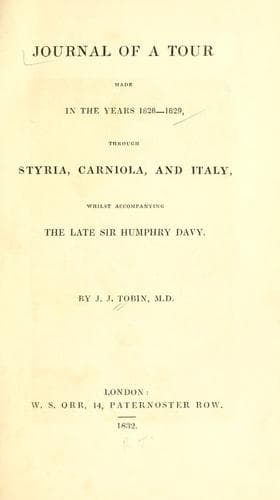
Journal of a Tour in the Years 1828-1829, through Styria, Carniola, and Italy, whilst Accompanying the Late Sir Humphry DavyTobin, J. J.
History
Journal of a Tour in the Years 1828-1829, through Styria, Carniola, and Italy, whilst Accompanying the Late Sir Humphry Davy
Tobin, J. J.
Davy, Humphry, Sir, 1778-1829; Europe -- Description and travel
We are here in the heart of Carniola, and it seems as if we were
already at the end of Germany, for the greater part of the people are
Servians, and appear to be as different in their manners and habits
as in their language from the northern Germans; the peasants are
servile to their superiors, boorish and uncivil towards strangers, and
ignorant to an extreme. The only language which they understand is the
_Slowenian_ or _Krainerisch_, which is said to bear great affinity to
the Russian; and I am told that when the Russian troops were in this
part of Europe, they and the peasants were on very good terms, as they
mutually understood each other. The sound of this language is not hard
or unpleasant, with the exception of one or two letters, which are not
met with in most European languages; those who understand German and
Krainerisch, inform me that the latter language possesses equal compass
and power with the former. The higher and middling classes mostly speak
German, and often Italian, and are polite and friendly in their manners.
The town of Laybach, though of a considerable size, and with a
population of about 15,000 inhabitants, offers nothing interesting.
It is divided into two parts by the river Laybach, a slow and usually
turbid stream of no great breadth. Four or five wooden bridges
unite the two parts of the town; they are broad and appear like the
continuation of the streets, being shut in on both sides by rows of
shops, so that the passenger is not aware that he is crossing the
river. The streets are generally narrow and dark, and of the churches,
which are numerous, the episcopal church is the first. On a hill above
the town are the remains of the ancient citadel, now only used as a
prison. The view from hence is fine and extensive, overlooking a vast
plain, bounded on one side by the lofty chain of the Carinthian Alps,
and on the other by lesser mountains, covered with one continuous and
immense wood, the ancient Hyrcinian forest, which stretches on almost
to the frontiers of Turkey; nearer to the town are a great number of
marshes, the theatre of Sir Humphry's daily sport. The garrison is
considerable, and both the officers and soldiers are fine men, and look
very well in their white and light blue uniforms.
Public-domain text, read in full here on John Shaqi.
Reviews
Reviews
No reviews yet
Be the first to share your thoughts on this work.
Join the Discussion
Join the discussion
Sign in to leave a comment or review.
Sign InorCreate an account