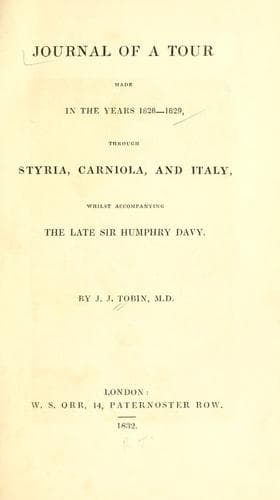
Journal of a Tour in the Years 1828-1829, through Styria, Carniola, and Italy, whilst Accompanying the Late Sir Humphry DavyTobin, J. J.
History
Journal of a Tour in the Years 1828-1829, through Styria, Carniola, and Italy, whilst Accompanying the Late Sir Humphry Davy
Tobin, J. J.
Davy, Humphry, Sir, 1778-1829; Europe -- Description and travel
_27th._ I started from Wurzen at eight o'clock with a guide, who said
that he was well acquainted with the pass across the Alps, and as he
told me we should find nothing to eat at Trenta, we took some cold meat
and eggs with us. At Kronau we turned into the beautiful defile which
lies behind this village, and which is called the Valley of Pisching,
from a little stream which flows through it, along whose banks we
walked briskly for about an hour and a half, surrounded on all sides
by rocky and magnificent mountains. At the end of the valley we turned
off to the right, and began to ascend one of the mountains by a very
rugged and steep path, passing sometimes through fir woods, and at
other times over white limestone rocks. After a very fatiguing ascent
of more than two hours, we found ourselves on the top of a pass between
two mountains. To our left was a still more lofty mountain, through
which, near the summit, there was a large hole like a window, so that
the blue sky was distinctly seen through it. My guide told me that
it was possible to ascend to this hole from the other side, but that
he had never been there. The descent to Trenta on the other side was
much worse than our ascent had been, the path or rather track that we
followed being every now and then impeded by great blocks of limestone
and shattered fir-trees. The points of view were very fine and wild,
though the whole seemed desolate and dreary. In less than an hour we
reached the valley and the few huts which form the hamlet of Trenta.
In the middle of the valley runs the Isonzo, which is seen gushing
forth from the rocks, and forming a magnificent cascade in a gulley
or crevice of the mountain, a few hundred yards distant from Trenta.
I immediately went to it, and found that the fall consisted of three
distinct cascades, one above the other, all three highly picturesque,
but chiefly so the upper one, which is by far the loftiest. My guide
said the quantity of water was not now so considerable as in general,
and that if I liked to go to the top of the uppermost fall I could see
the place from whence it issued out of the mountain. We accordingly
climbed up the rocks till we came to a heap of loose and detached
fragments of limestone, from under which the water appeared to issue,
but on climbing up still further, I came to a large opening in the
rock, through which a sunbeam fell, and upon looking into it, I saw
that within there was a large cavern filled with water perfectly clear,
and apparently of great depth, for when I threw in a large white stone
on the spot where the sunbeam played upon the water, I saw it descend
through it for a long time. Of the extent of this subterraneous lake
and cavern it was impossible to form any idea, for all beyond a few
feet from the opening was darkness. The peasants at Trenta call this
source the _Sorga_, and they told me that after great melting of the
snows the water rushes also out from the opening, and then forms a very
noble cascade.
Public-domain text, read in full here on John Shaqi.
Reviews
Reviews
No reviews yet
Be the first to share your thoughts on this work.
Elsewhere in the archive
Join the Discussion
Join the discussion
Sign in to leave a comment or review.
Sign InorCreate an account