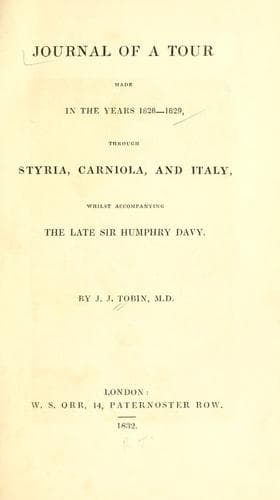
Journal of a Tour in the Years 1828-1829, through Styria, Carniola, and Italy, whilst Accompanying the Late Sir Humphry DavyTobin, J. J.
History
Journal of a Tour in the Years 1828-1829, through Styria, Carniola, and Italy, whilst Accompanying the Late Sir Humphry Davy
Tobin, J. J.
Davy, Humphry, Sir, 1778-1829; Europe -- Description and travel
_13th._ We left Adelsberg this morning, and after a drive of about
three hours through a wild and hilly country, we arrived at the
village of Zirknitz, on the borders of the celebrated Zirknitzer-See.
The inn, though small, had two decent rooms, and Sir Humphry determined
to remain here for a day or two, in order to shoot quails, which abound
in the neighbourhood; he accordingly went out in the afternoon with
his gun, accompanied by the innkeeper, who had recommended himself to
him by speaking Italian; and I went in the meantime to look at the
lake. Its banks are formed by mountains of no great height, completely
covered with forests of pine, and in the lake are three islands, each
of which has a different name. On the largest, called _Vomek_, is a
little village; the other two, _Goritza_ and _Malagoritza_, are smaller
and barren. The lake itself is of an oblong form, and, as I ascertained
from "The Chronicle of Carniola," (a voluminous and old work on the
history and geography of this part of Austria, by Baron Valvasor, and
the only book to be found in the inn,) about one German mile (four
and three quarters English) in length, and rather more than half a
one in breadth. Its depth varies, but it is no where considerable.
In different parts of it are large and deep conical holes, Valvasor
says eighteen, each of which has also a name: the chief of them are
_Koten_, _Zeschenza_, _Malabonarza_, _Velkioberk_, _&c._, and through
these holes the lake is filled with water. This generally takes place
annually, in October or November, and the water again disappears
through these holes in the beginning of summer.
In twenty days after the disappearance of the water, grass springs up,
and produces very good hay; numbers of birds flock to the fields, and
the bed of the lake then becomes a sporting ground. The disappearance
of the waters, however, is by no means certain, for sometimes a whole
year will elapse without the lake becoming dry, while at times it will
sink and re-appear twice, or even thrice, in one year. At the end
of the lake, near Zirknitz, are two large openings in a rock called
_Malakarlouza_ and _Valkakarlouza_, through which the water runs off
when the lake rises higher than usual. During the winter the lake is
generally frozen over. The temperature and colour of its water are
similar to that of the other lakes in this part of the country, though
the fish which inhabit it, chiefly pike, are said to be unwholesome.
By what means and from whence this lake is filled, it is very difficult
to say; the most probable conjecture is that it is supplied by some
vast reservoir of water in the interior of the earth, which may also be
the feeder of the many subterraneous rivers with which the surrounding
country abounds. Not a single stream flows out of the lake, but six
or seven small rivulets fall into it, the largest of which is the
_Zirknitzbach_. In the evening Sir Humphry returned from his sport,
bringing with him some quails and a few snipes.
Public-domain text, read in full here on John Shaqi.
Reviews
Reviews
No reviews yet
Be the first to share your thoughts on this work.
Elsewhere in the archive
Join the Discussion
Join the discussion
Sign in to leave a comment or review.
Sign InorCreate an account