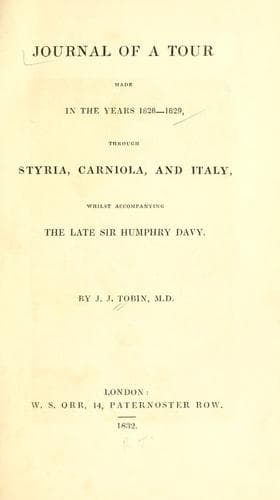
Journal of a Tour in the Years 1828-1829, through Styria, Carniola, and Italy, whilst Accompanying the Late Sir Humphry DavyTobin, J. J.
History
Journal of a Tour in the Years 1828-1829, through Styria, Carniola, and Italy, whilst Accompanying the Late Sir Humphry Davy
Tobin, J. J.
Davy, Humphry, Sir, 1778-1829; Europe -- Description and travel
_5th._ We quitted Treviso early this morning for Padua, with the
Ugonian or Paduan hills in front of us. About two miles out of the
town, looking across the marshes, we saw Venice with all her towers
rising, as it were, out of them. We were only about five miles from
this, the second most interesting city of Italy, nor could I help
expressing a wish to see it. Sir Humphry, however, said that he was
determined never again to enter it, for he had, upon a former journey,
been detained there _upwards of an hour_ about his passport. A little
beyond Mestre, a dirty and ruinous town, where passengers generally
embark for Venice, we came to the Brenta, and drove along its banks to
Dolo, a small village, where we dined. The road is lined with fine,
but mostly ruinous villas, in the light Italian style of architecture,
and between Dolo and Padua we passed by a magnificent palace belonging
to the Viceroy of Milan. We did not arrive at Padua till it was nearly
dark, and entered the town by an old Roman gateway, similar to that at
Treviso. The streets through which we passed were narrow and dirty, but
furnished on both sides with arcades for foot passengers.
_6th._ We left Padua at eight o'clock this morning, passing through
the Piazza San Antonio, a fine open square ornamented with statues, and
at one end of which is the cathedral church of St. Antonio, said to be
one of the churches containing the greatest number of votive altars in
Italy.
The country between Padua and Monselice, an insignificant little town
where we stopped to bait, is pretty. Crossing the Adige by a flying
bridge, we drove on to Rovigo; a town with about eight thousand
inhabitants, but with apparently nothing remarkable in it.
_7th._ After leaving Rovigo, we came in a few hours to the Po at
Polsella, a fine deep river, but very turbid and rapid. A poste
further we crossed it by a flying bridge, and quitting the Austrian
territories, we entered the Papal states. The _Douane_ is situated upon
the bank of the river, and although the _lascia-passare_, for which Sir
Humphry had written to Rome from Laibach, was not arrived, he had no
difficulty in passing unexamined, a little money being, it seems, here
as good as the best pass. We then drove on to Ferrara, where we lodged
at the _Tre Mori_, a very good inn, though badly situated in a very
narrow back street.
In the afternoon I walked through the old, deserted, and often
grass-grown streets of the town. In the Piazza Ariostea stands a fine
old column, and the church in the great square is a fine building
externally, the front consisting of numerous rows of arches one above
the other. This and the ancient castle or palace of the house of Esté,
a large moated brick building, with numerous square towers, in one of
which the dungeon of Tasso is still shown, are all that is worth seeing
here.
Public-domain text, read in full here on John Shaqi.
Reviews
Reviews
No reviews yet
Be the first to share your thoughts on this work.
Elsewhere in the archive
Join the Discussion
Join the discussion
Sign in to leave a comment or review.
Sign InorCreate an account