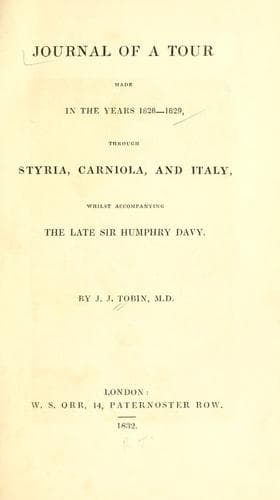
Journal of a Tour in the Years 1828-1829, through Styria, Carniola, and Italy, whilst Accompanying the Late Sir Humphry DavyTobin, J. J.
History
Journal of a Tour in the Years 1828-1829, through Styria, Carniola, and Italy, whilst Accompanying the Late Sir Humphry Davy
Tobin, J. J.
Davy, Humphry, Sir, 1778-1829; Europe -- Description and travel
_17th._ We left these wretched quarters at seven in the morning; and
quitting the Appenines, soon afterwards crossed the Tiber, already a
tolerably broad, but very muddy river. The whole country is volcanic,
and the river seems to flow here through the crater of some tremendous
volcano of a former world. At Borghetto, on the other side of the
river, are the remains of an old castle, probably gothic. The sides
of the roads, from hence to Citta Castellana, contain large masses of
white garnet, and we passed by many craters, small and large, some
only broad and deep pits, with trees growing out of the clefts of the
lava rock; others filled up with earth, and now turned into cultivated
fields. Citta, or Civita Castellana, is probably the ancient Veii, and
must have been a very strong place in former days. The citadel, from
which it takes its present name, is a large fort of half Roman, half
Gothic architecture. Before entering the town we crossed a small river,
which runs deep below through a wild and romantic fissure in the lava
rocks, which surround the town, and of which the greater part of the
houses are built. We passed through the town and over a bridge erected
by Pius VI. A pompous Latin inscription consigns the name of this pope
to posterity, for having ordered this bridge to be built. It is a good
strong bridge, but nothing more. The Romans of old built and worked,
and let others talk; those of the present day talk much and do nothing.
We then drove on to Nepi, a small village, where we dined, and from
hence through Monterosa to Baccano, which only consists of two inns,
the poste and another, where the vetturini generally stop. Sir Humphry
chose the latter, which we found very good. To-morrow we shall enter
Rome, which is only two postes distant from us.
_18th._ Left Baccano at eight in the morning, and in about half an
hour, from the top of the first hill, saw the Eternal City, with her
seven hills, her towers, cupolas, monuments, and palaces, immediately
before us, becoming more and more distinct as the sun dispersed the
mists of the morning, and bringing with them the recollections of
the times and deeds of old, and of the heroes, statesmen, orators,
and poets, whose former dwellings were there, and whose fame still
fills the world with admiration. On our left lay the long chain of
the Appenines, above which rose Monte Velino, and some other of the
more distant and snow-clad mountains, whilst nearer to Rome was seen
the Alban Mount, and the hills of Tivoli. On the right lay the wide
outstretching campagna, beyond which, although Sir Humphry doubted
it, I am sure I saw the straight blue line of the Mediterranean. The
carriage rolled on from hill to hill, each of which was covered with
villas surrounded by trees, amongst which the tall cypress and the
magnificent fan, or Mediterranean pine, were pre-eminent. At La Storta
we reached the last hill;
Public-domain text, read in full here on John Shaqi.
Reviews
Reviews
No reviews yet
Be the first to share your thoughts on this work.
Elsewhere in the archive
Join the Discussion
Join the discussion
Sign in to leave a comment or review.
Sign InorCreate an account