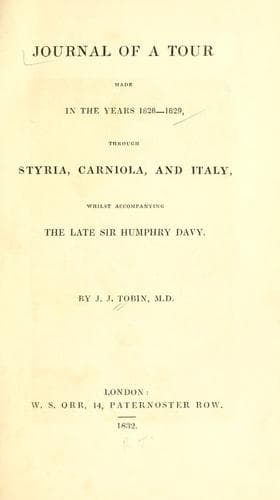
Journal of a Tour in the Years 1828-1829, through Styria, Carniola, and Italy, whilst Accompanying the Late Sir Humphry DavyTobin, J. J.
History
Journal of a Tour in the Years 1828-1829, through Styria, Carniola, and Italy, whilst Accompanying the Late Sir Humphry Davy
Tobin, J. J.
Davy, Humphry, Sir, 1778-1829; Europe -- Description and travel
----"Now the brow
We gain enraptured; beauteously distinct
The numerous porticoes and domes upswell,
With obelisks and columns interposed,
And pine, and fir, and oak; so fair a scene
Sees not the dervise from the spiral tomb
Of ancient Chammos, while his eye beholds
Proud Memphis' reliques o'er the Egyptian plain:
Nor hoary hermit from Hymettus' brow,
Though graceful Athens in the vale beneath."
From hence a short drive brought us to the Tiber and to the Ponte
Molle, a bridge of brick, built on the ancient foundations of the
_Pons Molvii_, in front of which stands a handsome gateway and tower.
Crossing this bridge, we drove along a straight broad street upwards of
a mile in length, which ends at the Porta del Popolo, the entrance into
Rome, and a magnificent entrance it is. The gate itself is fine, though
not very elegant, but the view through it into the Piazza del Popolo
is grand in the extreme, and strongly impresses the stranger with the
feeling that he is entering into a magnificent city, the metropolis
of religion and of the arts. In the middle of the Piazza, which is
formed of two large semicircles, rises a superb obelisk of red granite,
covered with hierogliphics; four lions of white marble spouting water
into the basins before them, form part of the pedestal. In the centre
of the back of each semicircle is a very elegant fountain in the shape
of a colossal shell, and surmounted by groups of gigantic statues.
Looking across the Piazza, three long streets present themselves
to view; the middle the Corso; the one on the left, the Strada del
Babuino; and to the right, the Strada di Ripetta. The ends of these
streets, facing the Piazza, are formed by two elegant churches,
perfectly similar in architecture, and above the left semicircle are
seen the gardens of the Monte Pincio, the ascent to which, adorned by
columns and statues, is not yet finished.
Having found our _lascia passare_ at the gate, we were permitted to
drive to the hotel directly, and were not first conducted to the
custom-house, as is the case with those who enter Rome without having
procured, through some friend, the permission to pass, which is only
given by the secretary of state.
Public-domain text, read in full here on John Shaqi.
Reviews
Reviews
No reviews yet
Be the first to share your thoughts on this work.
Elsewhere in the archive
Join the Discussion
Join the discussion
Sign in to leave a comment or review.
Sign InorCreate an account