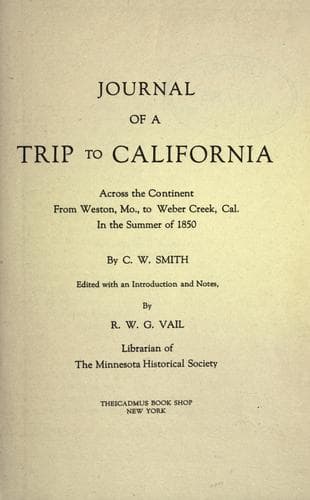
Journal of a Trip to California: Across the Continent from Weston, Mo., to Weber Creek, Cal., in the Summer of 1850Smith, Charles W.
History
Journal of a Trip to California: Across the Continent from Weston, Mo., to Weber Creek, Cal., in the Summer of 1850
Smith, Charles W.
Overland journeys to the Pacific; Smith, Charles W.
Off again early this morning and went seven miles before breakfast.
After breakfast we pushed on twelve miles more by one o'clock, when we
stopped to dine, by a small brook. Two miles more brought us to another
stream, which we crossed, and traveled on. Yesterday afternoon a mild
south wind prevailed, but fell in the night, when it became quite cold.
Toward morning, a perfect gale sprung up in the north, and though I laid
in the wagon, wrapped in a blanket, in heavy overcoat, I suffered very
much by the cold. The wind poured through our covering like cold water.
Thirty wagons passed us today--they all had feed for their teams. The
wind still raged this morning till about noon, when the sun shone out
and it began to get pleasant.
The country here assumes a more even appearance, and resembles in some
degree what I had anticipated. We have seen a great number of little
animals called prairie squirrels, resembling the ground squirrel of the
northern states. The ground is literally filled with their holes. I
have seen also a great many elk horns by the way; they are huge
specimens and indicate that a superior quality of game abounds here at
certain seasons of the year. A few prairie hens come in sight
occasionally, but are rather wild. No timber except on the water
courses, and upon these it is so hedged in by the hills that it cannot
be seen till you get close to it. In consequence of their ignorance of
the road, the emigrants carry wood and water where it is unnecessary,
and again, neglect to take it when needed; but this is unavoidable. The
heavy west winds drive a blinding dust in our faces, and in a few hours
a person becomes as black as a negro. Yesterday we met two United States
dragoons. They report some Indian depredations in advance of us. One is
that a family has been massacred by the Indians, and that the troops
from the Fort Laramie had pursued the murderers and put one hundred to
death. Our road so far has been most excellent, better than a turnpike,
as it is not so hard for the feet of teams. Generally the road is not
worn through the heavy turf but just deep enough to expose the roots of
the grass, which are as large as a man's little finger. Yet, from the
appearance of the road, there are a great many emigrants before us. Five
four-horse wagons passed us yesterday; they traveled fast, intended to
go forty per day and had feed sufficient for fifteen days, thirty
miles.
MAY 1.
Public-domain text, read in full here on John Shaqi.
Reviews
Reviews
No reviews yet
Be the first to share your thoughts on this work.
Join the Discussion
Join the discussion
Sign in to leave a comment or review.
Sign InorCreate an account