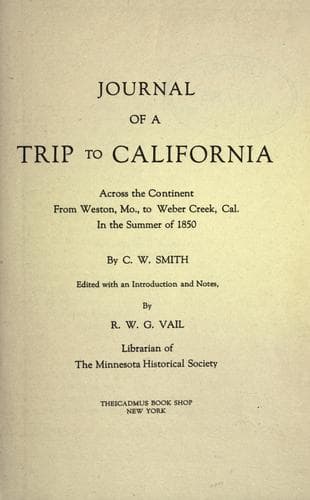
Journal of a Trip to California: Across the Continent from Weston, Mo., to Weber Creek, Cal., in the Summer of 1850Smith, Charles W.
History
Journal of a Trip to California: Across the Continent from Weston, Mo., to Weber Creek, Cal., in the Summer of 1850
Smith, Charles W.
Overland journeys to the Pacific; Smith, Charles W.
Traveling two miles this morning, we came to another Indian encampment
of some thirty-five tents. They were encamped upon a beautiful and
expansive plain. These Indians are of the same character of those we saw
yesterday. When we passed by, the sun was just rising and the scene was
quite picturesque. These Indians have a large number of ponies and
mules, which were scattered over the valley feeding, while several
Indians in their blue and white blankets and buffalo skins were watching
them. There were four or five dogs about each tent, and as we passed
they gave us a satisfactory display of vocal sounds. These dogs are an
inferior-looking brute and from imagination appear a little wolfish.
They howl rather than bark, and when a number of them are in concert, it
sounds singularly mournful and plaintive. The road becomes better as we
advance and the grass better than we have before seen. In fact, this is
the earliest period at which the grass can be considered fit for working
cattle. Distance, twenty miles.
MAY 25.
A short distance beyond our stopping place we crossed a small stream
called Small Creek. Soon after, we came in sight of those promised
curiosities, the Courthouse and Chimney Rock, the first appearing in the
distance like the dome of an immense building and the latter like a
tower or straight column. At noon, we came nearly opposite the Court
House, and as it appeared but a short distance from the road, some of
our men determined to go to it and satisfy their curiosity. They went,
and by fast walking, overtook us about four o'clock in the afternoon. It
is about seven miles from the trail, and appears very fine, being
discernable from all points. It is composed of an immense mass of rock,
raising from 300 to 500 feet above the level of the plain, and of a
conical shape at the summit, from which it derives its name. Chimney
Rock is about twelve miles further, and seven miles from where we stop
tonight. At noon we crossed another stream, the largest since we crossed
Little Blue River, and good water. It comes in from the south, a little
east of the Court House. This afternoon we had a fine specimen of a hail
storm in this region. A dark mass of clouds were gathering for several
hours in the west, till our path was overhung with an impenetrable
curtain of black, and at length the wind, which was blowing from the
east, turned back, and the storm rushed upon us. It was a real hail
storm. When it commenced beating upon our cattle, they became
intractable, but we succeeded in unfastening them from the wagons, and
having driven them behind the wagons, they bore it as well as might have
been expected. The hail stones were the largest I ever saw, some of them
being as large as hens' eggs, and striking with force sufficient to make
a man seek a shelter as soon as convenient. It continued some twenty
minutes, when it stopped and we commenced our march; but we had not gone
far when it recommenced, and we were compelled to turn around and wait
Public-domain text, read in full here on John Shaqi.
Reviews
Reviews
No reviews yet
Be the first to share your thoughts on this work.
Join the Discussion
Join the discussion
Sign in to leave a comment or review.
Sign InorCreate an account