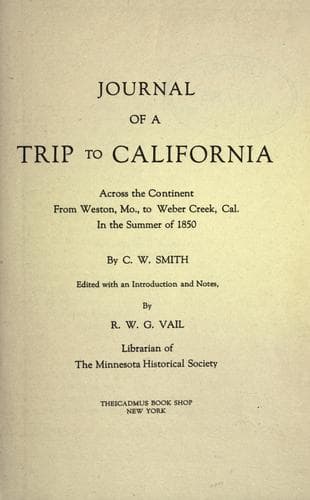
Journal of a Trip to California: Across the Continent from Weston, Mo., to Weber Creek, Cal., in the Summer of 1850Smith, Charles W.
History
Journal of a Trip to California: Across the Continent from Weston, Mo., to Weber Creek, Cal., in the Summer of 1850
Smith, Charles W.
Overland journeys to the Pacific; Smith, Charles W.
Quite cool last night, so much so that we could not keep warm between a
buffalo robe and two good blankets. The night before last was cold also.
Water froze over near our camp. After three miles' travel this morning
we came to what is called Dry Sandy. In the valley there is no water at
this season of the year. We passed down the valley six miles, when we
came to the fork in the roads--the Salt Lake and Subletts (?)--cut off,
the former leading down by Sandy and the latter keeping to the right,
west. Five miles more brought us to the Little Sandy, where we stopped
for the night. Tomorrow we shall go but six miles to Big Sandy, where we
shall prepare to cross a desert, as it is called, stretching from that
stream to Green River, a distance of forty miles, which is generally
traveled in the night. Distance, six miles.
JUNE 16.
Today we laid by to prepare to cross the desert from Big Sandy to Green
River. This afternoon I went up this stream about three miles to cut
grass for our cattle while crossing the desert. I was engaged half a day
in cutting two small sacks full with a knife. Then I came back to the
wagons and started down the stream for more grass, but found it more
scarce than ever. There is but little grass in this region, excepting
the creek bottoms, and they are few and narrow.
JUNE 17.
As it was agreed to start early, I went in company with some others to
fetch our cattle from some three miles up the river, where they had been
feeding. A snowstorm came on about daybreak and I had the full benefit
of it. I walked several miles in search of a couple of ponies that
belonged to the company and was at last compelled to return without
them. The face of the country there is nearly destitute of vegetation,
wild sage, greasewood and an occasional bunch of grass being the entire
product of the soil. We left Big Sandy at about eleven and a half A.
M. with the intention of traveling all night and reaching Green
River the next morning. We pushed on as fast as we could against a
strong wind and a blinding dust. A little before sundown we stopped an
hour for supper and to feed our cattle, having gone fifteen miles. This
over, we entered the night, and the most tedious part of our journey.
With the sun went down the wind and we hoped that an agreeable night
would follow such a boisterous day. But we were disappointed. A dark
cloud overcast the sky and soon a snowstorm came drifting in our faces,
and continued all night. At twelve o'clock we stopped to rest and feed
our cattle, and then pushed on till eight o'clock in the morning, when
we reached the Green River. The country between these streams is not so
barren as I was led to suppose. It is but little more so than much of
the ground we had passed over before, west of Fort Laramie. Green River
is about 1,000 feet lower than Big Sandy. Upon this stretch of forty
miles there is not a drop of water, and this is the reason why it is so
barren. Our cattle stood the drive very well.
Public-domain text, read in full here on John Shaqi.
Reviews
Reviews
No reviews yet
Be the first to share your thoughts on this work.
Join the Discussion
Join the discussion
Sign in to leave a comment or review.
Sign InorCreate an account