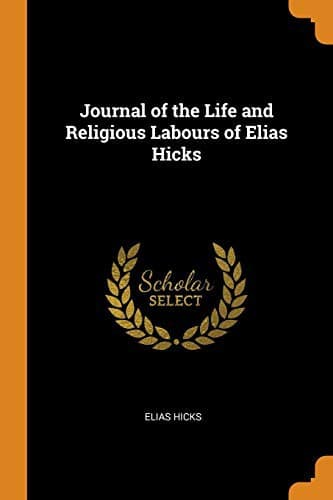
Journal of the Life and Religious Labours of Elias HicksHicks, Elias
Religion
Journal of the Life and Religious Labours of Elias Hicks
Hicks, Elias
Hicks, Elias, 1748-1830 -- Diaries; Hicksites; Quakers -- United States -- Diaries
I have likewise from reflection, founded on observation, and from the
nature and reason of things, been led to believe, that we frequently
err by the liberty we take in destroying what we esteem noxious
creatures; and not only abuse the power given us over them by our great
Creator, but likewise act very contrary to our own true interest.
For, as all in the beginning was pronounced good that the good God
had made, we ought not to destroy any thing that has life, for mere
gratification. It is our indispensable duty, as reasonable accountable
beings, wisely to ponder our ways, and consider the consequent effect
of all our conduct; for if we are to give an account of every idle
word, how much more so of every presumptuous act.
In the twenty-second year of my age, apprehending it right to change
my situation from a single to a married state, and having gained an
intimate acquaintance with Jemima Seaman, daughter of Jonathan and
Elizabeth Seaman, of Jericho, and my affection being drawn towards
her in that relation, I communicated my views to her, and received
from her a corresponding expression of affection; and having the full
unity and concurrence of our parents and friends, we, after some time,
accomplished our marriage at a solemn meeting of Friends, at Westbury,
on the 2d of 1st month, 1771. On this important occasion, we felt the
clear and consoling evidence of divine truth, and it remained with us
as a seal upon our spirits, strengthening us mutually to bear, with
becoming fortitude, the vicissitudes and trials which fell to our lot,
and of which we had a large share in passing through this probationary
state. My wife, although not of a very strong constitution, lived
to be the mother of eleven children, four sons and seven daughters.
Our second daughter, a very lovely promising child, died when young
with the small pox, and the youngest was not living at its birth. The
rest all arrived to years of discretion, and afforded us considerable
comfort, as they proved to be in a good degree dutiful children. All
our sons, however, were of weak constitutions, and were not able to
take care of themselves, being so enfeebled as not to be able to walk
after the ninth or tenth year of their age. The two eldest died in the
fifteenth year of their age, the third in his seventeenth year, and the
youngest was nearly nineteen when he died. But, although thus helpless,
the innocency of their lives, and the resigned cheerfulness of their
dispositions to their allotments, made the labour and toil of taking
care of them agreeable and pleasant; and I trust we were preserved from
murmuring or repining, believing the dispensation to be in wisdom, and
according to the will and gracious disposing of an all-wise providence,
for purposes best known to himself. And when I have observed the great
anxiety and affliction, which many parents have with undutiful children
who are favoured with health, especially their sons, I could perceive
Public-domain text, read in full here on John Shaqi.
Reviews
Reviews
No reviews yet
Be the first to share your thoughts on this work.
Join the Discussion
Join the discussion
Sign in to leave a comment or review.
Sign InorCreate an account