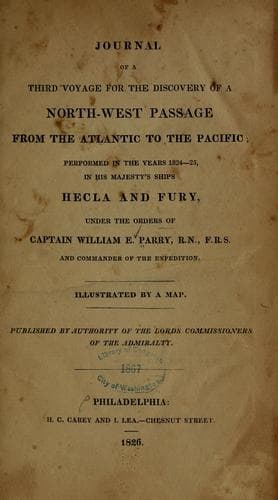
Journal of the Third Voyage for the Discovery of a North-West PassageParry, William Edward, Sir
History
Journal of the Third Voyage for the Discovery of a North-West Passage
Parry, William Edward, Sir
Arctic regions -- Discovery and exploration -- British; Fury (Ship); Hecla (Ship); Northwest Passage
The scent of the Esquimaux dogs is excellent; and this property is turned
to account by their masters in finding the seal holes, which these
invaluable animals will discover entirely by the smell at a very great
distance. The track of a single deer upon the snow will in like manner
set them off at a full gallop, when travelling, at least a quarter of a
mile before they arrive at it, when they are with difficulty made to turn
in any other direction; and the Esquimaux are accustomed to set them
after those animals to hunt them down when already wounded with an arrow.
In killing bears the dogs act a very essential part, and two or three of
them when led on by a man will eagerly attack one of those ferocious
creatures. An Esquimaux seldom uses any other weapon than his spear and
_panna_ in this encounter, for which the readiness of the dogs may be
implied from the circumstance of the word “nennook” (bear), being often
used to encourage them when running in a sledge. Indeed, the only animal
which they are not eager to chase is the wolf, of which the greater part
of them seem to have an instinctive dread, giving notice at night of
their approach to the huts by a loud and continued howl. There is not
one dog in twenty among them that will voluntarily, or indeed without a
great deal of beating, take the water if they think it is out of their
depth, and the few that would do so were spoken of as extraordinary
exceptions.
The Esquimaux in general treat their dogs much as an unfeeling master
does his slaves; that is, they take just as much care of them as their
own interest is supposed to require. The bitches with young are in the
winter allowed to occupy a part of their own beds, where they are
carefully attended and fed by the women, who will even supply the young
ones with meat and water from their mouths as they do their own children,
and not unfrequently also carry them in their hoods to take care of them.
It is probably on this account that the dogs are always so much attached
to the women, who can at any time catch them or entice them from the huts
when the men fail. Two females that were with young on board the _Fury_
in the month of February brought forth six and seven at a litter, and the
former number were all females. Their feeding, which, both in summer and
winter, principally consists of _kāŏw_, or the skin and part of the
blubber of the walrus, is during the latter season very precarious, their
masters having then but little to spare. They therefore become extremely
thin at that time of the year, and would scarcely be recognised as the
same animals as when regularly fed in the summer. No wonder therefore
that they will eat almost anything however tough or filthy, and that
neither whipping nor shouting will prevent their turning out of the road,
even when going at full speed, to pick up whatever they espy. When at
the huts they are constantly creeping in to pilfer what they can, and
Public-domain text, read in full here on John Shaqi.
Reviews
Reviews
No reviews yet
Be the first to share your thoughts on this work.
Elsewhere in the archive
Join the Discussion
Join the discussion
Sign in to leave a comment or review.
Sign InorCreate an account