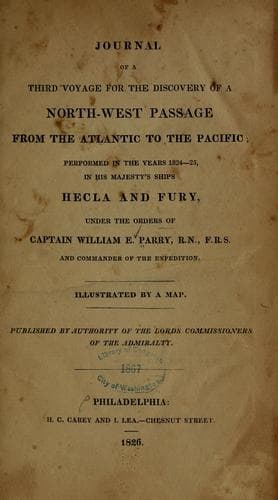
Journal of the Third Voyage for the Discovery of a North-West PassageParry, William Edward, Sir
History
Journal of the Third Voyage for the Discovery of a North-West Passage
Parry, William Edward, Sir
Arctic regions -- Discovery and exploration -- British; Fury (Ship); Hecla (Ship); Northwest Passage
With heavy loads the dogs draw best with one of their own people,
especially a woman, walking a little way ahead; and in this case they are
sometimes enticed to mend their pace by holding a mitten to the mouth,
and then making the motion of cutting it with a knife, and throwing it on
the snow, when the dogs, mistaking it for meat, hasten forward to pick it
up. The women also entice them from the huts in a similar manner. The
rate at which they travel depends, of course, on the weight they have to
draw, and the road on which their journey is performed. When the latter
is level and very hard and smooth, constituting what in other parts of
North America is called “good sleighing,” six or seven dogs will draw
from eight to ten hundredweight, at the rate of seven or eight miles an
hour, for several hours together, and will easily under those
circumstances perform a journey of fifty or sixty miles a day; on
untrodden snow, five-and-twenty or thirty miles would be a good day’s
journey. The same number of well-fed dogs, with a weight of only five or
six hundred pounds (that of the sledge included), are almost
unmanageable, and will on a smooth road run any way they please at the
rate of ten miles an hour. The work performed by a greater number of
dogs is, however, by no means in proportion to this, owing to the
imperfect mode already described of employing the strength of these
sturdy creatures, and to the more frequent snarling and fighting
occasioned by an increase of numbers.
In the summer, when the absence of snow precludes the use of sledges, the
dogs are still made useful on journeys and hunting excursions, by being
employed to carry burdens in a kind of saddle-bags laid across their
shoulders. A stout dog thus accoutred will accompany his master, laden
with a weight of about twenty to twenty-five pounds. When leading the
dogs, the Esquimaux take a half hitch with the trace round their necks to
prevent their pulling, and the same plan is followed when a sledge is
left without a keeper. They are also in the habit of tethering them,
when from home, by tying up one of the fore-legs; but a still more
effectual method is similar to that which we saw employed by the
Greenlanders of Prince Regent’s Bay, and consists in digging with their
spears two holes in the ice in an oblique direction and meeting each
other, so as to leave an eye-bolt, to which the dogs are fastened.
Public-domain text, read in full here on John Shaqi.
Reviews
Reviews
No reviews yet
Be the first to share your thoughts on this work.
Elsewhere in the archive
Join the Discussion
Join the discussion
Sign in to leave a comment or review.
Sign InorCreate an account