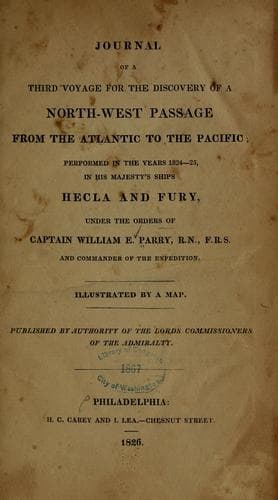
Journal of the Third Voyage for the Discovery of a North-West PassageParry, William Edward, Sir
History
Journal of the Third Voyage for the Discovery of a North-West Passage
Parry, William Edward, Sir
Arctic regions -- Discovery and exploration -- British; Fury (Ship); Hecla (Ship); Northwest Passage
When not more than eight years old the boys are taken by their fathers on
their sealing excursions, where they begin to learn their future
business; and even at that early age they are occasionally intrusted to
bring home a sledge and dogs from a distance of several miles over the
ice. At the age of eleven we see a boy with his watertight boots and
moccasins, a spear in his hand, and a small coil of line at his back,
accompanying the men to the fishery, under every circumstance; and from
this time his services daily increase in value to the whole tribe. On
our first intercourse with them we supposed that they would not
unwillingly have parted with their children in consideration of some
valuable present, but in this we afterwards found that we were much
mistaken. Happening one day to call myself Toolooak’s _attata_ (father),
and pretend that he was to remain with me on board the ship, I received
from the old man, his father, no other answer than what seemed to be very
strongly and even satirically implied, by his taking one of our gentlemen
by the arm and calling him his son; thus intimating that the adoption
which he proposed was as feasible and as natural as my own.
The custom of adoption is carried to very great lengths among these
people, and served to explain to us several apparent inconsistencies with
respect to their relationships. The adoption of a child in civilised
countries has usually for its motive either a tenderness for the object
itself, or some affection or pity for its deceased, helpless, or unknown
parents. Among the Esquimaux, however, with whom the two first of these
causes would prove but little excitement, and the last can have no place,
the custom owes its origin entirely to the obvious advantage of thus
providing for a man’s own subsistence in advanced life; and it is
consequently confined almost without exception to the adoption of sons,
who can alone contribute materially to the support of an aged and infirm
parent. When a man adopts the son of another as his own, he is said to
“_tego_,” or take him; and at whatever age this is done (though it
generally happens in infancy), the child then lives with his new parents,
calls them father and mother, is sometimes even ignorant of any such
transfer having been made, especially if his real parents should be dead;
and whether he knows it or not, is not always willing to acknowledge any
but those with whom he lives. Without imputing much to the natural
affection of these people for their offspring, which, like their other
passions, is certainly not remarkable for its strength, there would seem,
on the score of disinterestedness, a degree of consideration in a man’s
thus giving his son to another, which is scarcely compatible with the
general selfishness of the Esquimaux character; but there is reason to
suppose that the expediency of this measure is sometimes suggested by a
deficiency of the mother’s milk, and not unfrequently perhaps by the
Public-domain text, read in full here on John Shaqi.
Reviews
Reviews
No reviews yet
Be the first to share your thoughts on this work.
Elsewhere in the archive
Join the Discussion
Join the discussion
Sign in to leave a comment or review.
Sign InorCreate an account