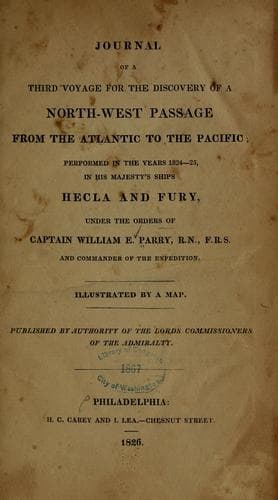
Journal of the Third Voyage for the Discovery of a North-West PassageParry, William Edward, Sir
History
Journal of the Third Voyage for the Discovery of a North-West Passage
Parry, William Edward, Sir
Arctic regions -- Discovery and exploration -- British; Fury (Ship); Hecla (Ship); Northwest Passage
The affection of parents for their children was frequently displayed by
these people, not only in the mere passive indulgence, and abstinence
from corporal punishment, for which Esquimaux have before been remarked,
but by a thousand playful endearments also, such as parents and nurses
practise in our own country. Nothing indeed can well exceed the kindness
with which they treat their children; and this trait in their character
deserves to be the more insisted on, because it is in reality the only
very amiable one which they possess. It must be confessed, indeed, that
the gentleness and docility of the children are such as to occasion their
parents little trouble, and to render severity towards them quite
unnecessary. Even from their earliest infancy, they possess that quiet
disposition, gentleness of demeanour, and uncommon evenness of temper,
for which in more mature age they are for the most part distinguished.
Disobedience is scarcely ever known, a word or even a look from a parent
is enough; and I never saw a single instance of that frowardness and
disposition to mischief which with our youth so often requires the whole
attention of a parent to watch over and to correct. They never cry from
trifling accidents, and sometimes not even from very severe hurts, at
which an English child would sob for an hour. It is indeed astonishing
to see the indifference with which, even as tender infants, they bear the
numerous blows they accidentally receive when carried at their mothers’
backs.
They are just as fond of play as any other young people, and of the same
kind; only that while an English child draws a cart of wood, an Esquimaux
of the same age has a sledge of whalebone; and for the superb baby-house
of the former, the latter builds a miniature hut of snow, and begs a
lighted wick from her mother’s lamp to illuminate the little dwelling.
Their parents make for them, as dolls, little figures of men and women,
habited in the true Esquimaux costume, as well as a variety of other
toys, many of them having some reference to their future occupations in
life, such as canoes, spears, and bows and arrows. The drum or
tambourine, mentioned by Crantz, is common among them, and used not only
by the children, but by the grown-up people at some of their games. They
sometimes serrate the edges of two strips of whalebone and whirl them
round their heads, just as boys do in England to make the same peculiar
humming sound. They will dispose one piece of wood on another, as an
axis, in such a manner that the wind turns it round like the arms of a
windmill; and so of many other toys of the same simple kind. These are
the distinct property of the children, who will sometimes sell them while
their parents look on, without interfering or expecting to be consulted.
Public-domain text, read in full here on John Shaqi.
Reviews
Reviews
No reviews yet
Be the first to share your thoughts on this work.
Elsewhere in the archive
Join the Discussion
Join the discussion
Sign in to leave a comment or review.
Sign InorCreate an account