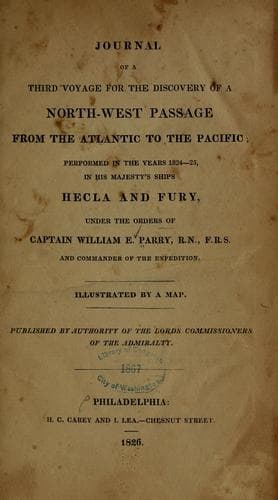
Journal of the Third Voyage for the Discovery of a North-West PassageParry, William Edward, Sir
History
Journal of the Third Voyage for the Discovery of a North-West Passage
Parry, William Edward, Sir
Arctic regions -- Discovery and exploration -- British; Fury (Ship); Hecla (Ship); Northwest Passage
If, in short, they are deficient in some of the higher virtues, as they
are called, of savage life, they are certainly free also from some of its
blackest vices; and their want of brilliant qualities is fully
compensated by those which, while they dazzle less, do more service to
society and more honour to human nature. If, for instance, they have not
the magnanimity which would enable them to endure without a murmur the
most excruciating torture, neither have they the ferocious cruelty that
incites a man to inflict that torture on a helpless fellow-creature. If
their gratitude for favours be not lively nor lasting, neither is their
resentment of injuries implacable, nor their hatred deadly. I do not say
there are not exceptions to this rule, though we have never witnessed
any; but it is assuredly not their general character.
When viewed more nearly in their domestic relations, the comparison will,
I believe, be still more in their favour. It is here as a social being,
as a husband and the father of a family, promoting within his own little
sphere the benefit of that community in which Providence has cast his
lot, that the moral character of a savage is truly to be sought; and who
can turn without horror from the Esquimaux, peaceably seated after a day
of honest labour with his wife and children in their snow-built hut, to
the self-willed and vindictive Indian, wantonly plunging his dagger into
the bosom of the helpless woman whom nature bids him cherish and protect!
Of the few arts possessed by this simple people some account has already
been given in the description of their various implements. As mechanics,
they have little to boast when compared with other savages lying under
equal disadvantages as to scantiness of tools and materials. As
carpenters, they can scarf two pieces of wood together, secure them with
pins of whalebone or ivory, fashion the timbers of a canoe, shoe a
paddle, and rivet a scrap of iron into a spear or arrow head. Their
principal tool is the knife (_panna_), and, considering the excellence of
a great number which they possessed previous to our intercourse with
them, the work they do is remarkably coarse and clumsy. Their very
manner of holding and handling a knife is the most awkward that can be
imagined. For the purpose of boring holes they have a drill and bow so
exactly like our own that they need no further description, except that
the end of the drill-handle, which our artists place against their
breast, is rested by these people against a piece of wood or bone held in
their mouths, and having a cavity fitted to receive it. With the use of
the saw they were well acquainted, but had nothing of this kind in their
possession better than a notched piece of iron. One or two small
European axes were lashed to handles in a contrary direction to ours;
that is, to be used like an adze, a form which, according to the
observation of a traveller well qualified to judge, savages in general
prefer.
Public-domain text, read in full here on John Shaqi.
Reviews
Reviews
No reviews yet
Be the first to share your thoughts on this work.
Elsewhere in the archive
Join the Discussion
Join the discussion
Sign in to leave a comment or review.
Sign InorCreate an account