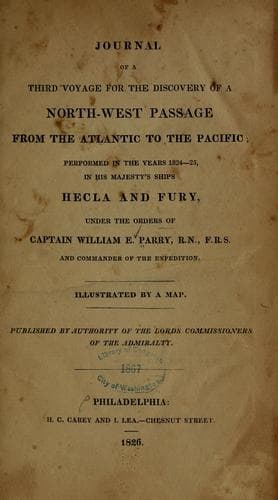
Journal of the Third Voyage for the Discovery of a North-West PassageParry, William Edward, Sir
History
Journal of the Third Voyage for the Discovery of a North-West Passage
Parry, William Edward, Sir
Arctic regions -- Discovery and exploration -- British; Fury (Ship); Hecla (Ship); Northwest Passage
It was said that these people steamed or boiled wood in order to
bend it for fashioning the timbers of their canoes. As fishermen or
seamen, they can put on a woolding or seizing with sufficient strength
and security, and are acquainted with some of the most simple and
serviceable knots in use among us. In all the arts, however, practised
by the men, it is observable that the ingenuity lies in the principle,
not in the execution. The experience of ages has led them to adopt the
most efficacious methods, but their practice as handicrafts has gone no
further than absolute necessity requires; they bestow little labour upon
neatness or ornament.
In some of the few arts practised by the women there is much more
dexterity displayed, particularly in that important branch of a
housewife’s business, sewing, which even with their own clumsy needles of
bone they perform with extraordinary neatness. They had, however,
several steel needles of a three-cornered shape, which they kept in a
very convenient case, consisting of a strip of leather passed through a
hollow bone and having its ends remaining out, so that the needles which
are stuck into it may be drawn in and out at pleasure. These cases were
sometimes ornamented by cutting; and several thimbles of leather, one of
which in sewing is worn on the first finger, are usually attached to it,
together with a bunch of narrow spoons and other small articles liable to
be lost. The thread they use is the sinew of the reindeer (_tooktoo
ĕwāllŏŏ_), or, when they cannot procure this, the swallow-pipe of the
_neitiek_. This may be split into threads of different sizes, according
to the nature of their work, and is certainly a most admirable material.
This, together with any other articles of a similar kind, they keep in
little bags, which are sometimes made of the skin of birds’ feet,
disposed with the claws downwards in a very neat and tasteful manner. In
sewing, the point of the needle is entered and drawn through in a
direction towards the body, and not from it or towards one side, as with
our sempstresses. They sew the deer-skins with a “round seam,” and the
water-tight boots and shoes are “stitched.” The latter is performed in a
very adroit and efficacious manner, by putting the needle only half
through the substance of one part of the seal-skin, so as to leave no
hole for admitting the water. In cutting out the clothes, the women do
it after one regular and uniform pattern, which probably descends
unaltered from generation to generation. The skin of the deer’s head is
always made to form the apex of the hood, while that of the neck and
shoulders comes down the back of the jacket; and so of every other part
of the animal, which is appropriated to its particular portion of the
dress. To soften the seal-skins of which the boots, shoes, and mittens
are made, the women chew them for an hour or two together, and the young
girls are often seen employed in thus preparing the materials for their
Public-domain text, read in full here on John Shaqi.
Reviews
Reviews
No reviews yet
Be the first to share your thoughts on this work.
Elsewhere in the archive
Join the Discussion
Join the discussion
Sign in to leave a comment or review.
Sign InorCreate an account