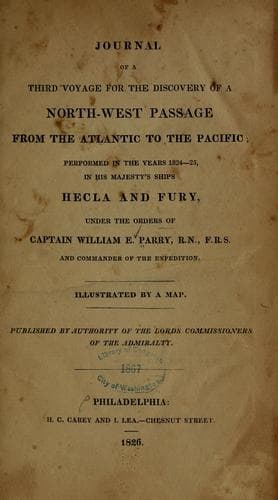
Journal of the Third Voyage for the Discovery of a North-West PassageParry, William Edward, Sir
History
Journal of the Third Voyage for the Discovery of a North-West Passage
Parry, William Edward, Sir
Arctic regions -- Discovery and exploration -- British; Fury (Ship); Hecla (Ship); Northwest Passage
seem, however, to take great delight in it; and even a number of the men,
as well as all the children, crept into the hut by degrees to peep at the
performance.
The Esquimaux women and children often amuse themselves with a game not
unlike our “skip-rope.” This is performed by two women holding the ends
of a line and whirling it regularly round and round, while a third jumps
over it in the middle according to the following order:—She commences by
jumping twice on both feet, then alternately with the right and left, and
next four times with the feet slipped one behind the other, the rope
passing once round at each jump. After this she performs a circle on the
ground, jumping about half-a-dozen times in the course of it, which
bringing her to her original position, the same thing is repeated as
often as it can be done without entangling the line. One or two of the
women performed this with considerable agility and adroitness,
considering the clumsiness of their boots and jackets, and seemed to
pride themselves in some degree on the qualification. A second kind of
this game consists in two women holding a long rope by its ends and
whirling it round in such a manner, over the heads of two others standing
close together near the middle of the bight, that each of these shall
jump over it alternately. The art therefore, which is indeed
considerable, depends more on those whirling the rope than on the
jumpers, who are, however, obliged to keep exact time, in order to be
ready for the rope passing under their feet.
The whole of these people, but especially the women, are fond of music,
both vocal and instrumental. Some of them might be said to be
passionately so, removing their hair from off their ears and bending
their heads forward, as if to catch the sounds more distinctly, whenever
we amused them in this manner. Their own music is entirely vocal, unless
indeed the drum or tambourine before mentioned be considered an
exception.
The voices of the women are soft and feminine, and when singing with the
men are pitched an octave higher than theirs. They have most of them so
far good ears that, in whatever key a song is commenced by one of them,
the rest will always join in perfect unison. After singing for ten
minutes, the key had usually fallen a full semitone. Only two of them,
of whom Iligliuk was one, could catch the tune as pitched by an
instrument; which made it difficult with most of them to complete the
writing of the notes, for if they once left off they were sure to
re-commence in some other key, though a flute or violin were playing at
the time.
Public-domain text, read in full here on John Shaqi.
Reviews
Reviews
No reviews yet
Be the first to share your thoughts on this work.
Elsewhere in the archive
Join the Discussion
Join the discussion
Sign in to leave a comment or review.
Sign InorCreate an account