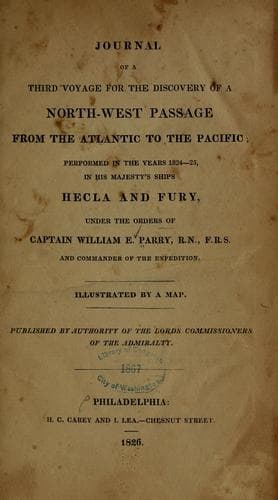
Journal of the Third Voyage for the Discovery of a North-West PassageParry, William Edward, Sir
History
Journal of the Third Voyage for the Discovery of a North-West Passage
Parry, William Edward, Sir
Arctic regions -- Discovery and exploration -- British; Fury (Ship); Hecla (Ship); Northwest Passage
During the season passed at Winter Island, which appears to have been a
healthy one to the Esquimaux, we had little opportunity of becoming
acquainted with the diseases to which they are subject. Our subsequent
intercourse with a greater number of these people at Igloolik having
unfortunately afforded more frequent and fatal instances of sickness
among them, I here insert Mr. Edwards’s remarks on this subject:—
“Exempted as these people are from a host of diseases usually ascribed to
the vitiated habits of more civilised life, as well as from those equally
numerous and more destructive ones engendered by the pestilential
effluvia that float in the atmosphere of more favoured climes, the
diversity of their maladies is, as might _à priori_ be inferred, very
limited. But, unfortunately, that improvidence which is so remarkable in
their kindred tribes is also with them proof against the repeated lessons
of bitter experience they are doomed to endure. Alternate excesses and
privations mark their progress through life, and consequent misery in one
or another shape is an active agent in effecting as much mischief amongst
them as the diseases above alluded to produce in other countries. The
mortality arising from a few diseases and wretchedness combined, seems
sufficient to check anything like a progressive increase of their
numbers. The great proportion of deaths to births that occurred during
the period of our intercourse with them has already been noticed.
“It is doubtful in what proportion the mortality is directly occasioned
by disease. Few perhaps die, in the strict sense of the term, a natural
death. A married person of either sex rarely dies without leaving
destitute a parent, a widow, or a helpless female infant. To be deprived
of near relations is to be deprived of everything; such unfortunates are
usually abandoned to their fate, and too generally perish. A widow and
two or three children left under these circumstances were known to have
died of inanition, from the neglect and apathy of their neighbours, who
jeered at the commanders of our ships on the failure of their humane
endeavours to save what the Esquimaux considered as worthless.
Public-domain text, read in full here on John Shaqi.
Reviews
Reviews
No reviews yet
Be the first to share your thoughts on this work.
Elsewhere in the archive
Join the Discussion
Join the discussion
Sign in to leave a comment or review.
Sign InorCreate an account