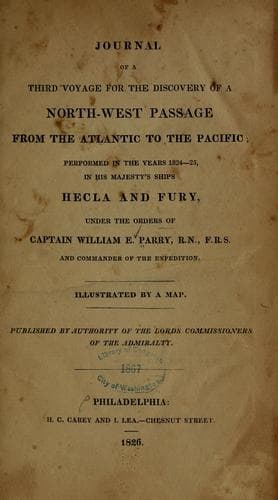
Journal of the Third Voyage for the Discovery of a North-West PassageParry, William Edward, Sir
History
Journal of the Third Voyage for the Discovery of a North-West Passage
Parry, William Edward, Sir
Arctic regions -- Discovery and exploration -- British; Fury (Ship); Hecla (Ship); Northwest Passage
her countenance sallow, lips pale, and she suffered under general
debility, without local pain or rigidity of the limbs. She remained in
this state for a long time, and eventually, as the weather improved,
recovered without assistance.
“That affection of the eyes known by the name of snow-blindness, is
extremely frequent among these people. With them it scarcely ever goes
beyond painful irritation, whilst among strangers inflammation is
sometimes the consequence. I have not seen them use any other remedy
besides the exclusion of light; but as a preventive a wooden eye-screen
is worn, very simple in its construction, consisting of a curved piece of
wood six or seven inches long and ten or twelve lines broad. It is tied
over the eyes like a pair of spectacles, being adapted to the forehead
and nose, and hollowed out to favour the motion of the eyelids. A few
rays of light only are admitted through a narrow slit an inch long, cut
opposite to each eye. This contrivance is more simple and quite as
efficient as the more heavy one possessed by some who have been fortunate
enough to acquire wood for the purpose. This is merely the former
instrument complicated by the addition of a horizontal plate projecting
three or four inches from its upper rim, like the peak of a jockey’s cap.
In Hudson’s Strait the latter is common, and the former in Greenland,
where also we are told they wear with advantage the simple horizontal
peak alone.
“There are upon the whole no people more destitute of curative means than
these. With the exception of the hemorrhage already mentioned, which
they duly appreciate, and have been observed to excite artificially to
cure head-ache, they are ignorant of any rational method of procuring
relief. It has not been ascertained that they use a single herb
medicinally. As prophylactics they wear amulets, which are usually the
teeth, bones, or hair of some animal, the more rare apparently the more
valuable. In absolute sickness they depend entirely upon their Angekoks,
who, they persuade themselves, have influence over some submarine deities
who govern their destiny. The mummeries of these impostors, consisting
in pretended consultations with their oracles, are looked upon with
confidence, and their mandates, however absurd, superstitiously submitted
to. These are constituted of unmeaning ceremonies and prohibitions
generally affecting the diet, both in kind and mode, but never in
quantity. Seal’s flesh is forbidden, for instance, in one disease, that
of the walrus in the other; the heart is denied to some and the liver to
others. A poor woman, on discovering that the meat she had in her mouth
was a piece of fried heart instead of the liver, appeared horrorstruck;
and a man was in equal tribulation at having eaten, by mistake, a piece
of meat cooked in his wife’s kettle.
Public-domain text, read in full here on John Shaqi.
Reviews
Reviews
No reviews yet
Be the first to share your thoughts on this work.
Elsewhere in the archive
Join the Discussion
Join the discussion
Sign in to leave a comment or review.
Sign InorCreate an account