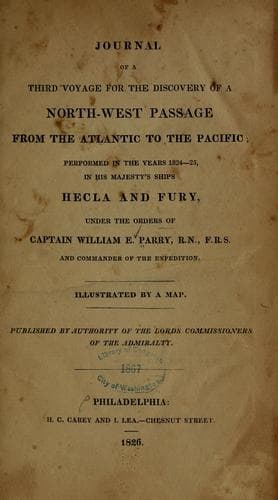
Journal of the Third Voyage for the Discovery of a North-West PassageParry, William Edward, Sir
History
Journal of the Third Voyage for the Discovery of a North-West Passage
Parry, William Edward, Sir
Arctic regions -- Discovery and exploration -- British; Fury (Ship); Hecla (Ship); Northwest Passage
“This charlatanerie, although we may ridicule the imposition, is not,
however, with them, as it is with us, a positive evil. In the total
absence of the medical art, it proves generally innoxious; while in many
instances it must be a source of real benefit and comfort, by buoying up
the sick spirit with confident hopes of recovery, and eventually enabling
the vital powers to rise superior to the malady, when, without such
support, the sufferer might have sunk under its weight. It was attempted
to ascertain whether climate effected any difference in animal heat
between them and ourselves by frequently marking the temperature of the
mouth; but the experiments were necessarily made, as occasion offered,
under such various states of vascular excitement, as to afford nothing
conclusive. As it was, their temperature varied from 97° to 102°,
coinciding pretty nearly with our own under similar circumstances. The
pulse offered nothing singular.
“I may here remark that there is in many individuals a peculiarity about
the eye, amounting in some instances to deformity, which I have not
noticed elsewhere. It consists in the inner corner of the eye being
entirely covered by a duplication of the adjacent loose skin of the
eyelids and nose. This fold is lightly stretched over the edges of the
eyelids, and forms, as it were, a third palpebra of a crescentic shape.
The aperture is in consequence rendered somewhat pyriform, the inner
curvature being very obtuse, and in some individuals distorted by an
angle formed where the fold crosses the border of the lower palpebra.
This singularity depends upon the variable form of the orbit during
immature age, and is very remarkable in childhood, less so towards adult
age, and then, it would seem, frequently disappearing altogether; for the
proportion in which it exists among grown-up persons bears but a small
comparison with that observed among the young.
“Personal deformity from mal-conformation is uncommon, the only instance
I remember being that of a young woman, whose utterance was
unintelligibly nasal, in consequence of an imperfect development of the
palatine bones leaving a gap in the roof of the mouth.”
Public-domain text, read in full here on John Shaqi.
Reviews
Reviews
No reviews yet
Be the first to share your thoughts on this work.
Elsewhere in the archive
Join the Discussion
Join the discussion
Sign in to leave a comment or review.
Sign InorCreate an account