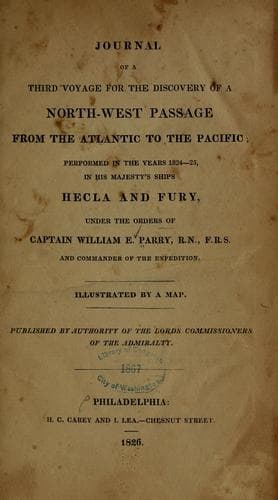
Journal of the Third Voyage for the Discovery of a North-West PassageParry, William Edward, Sir
History
Journal of the Third Voyage for the Discovery of a North-West Passage
Parry, William Edward, Sir
Arctic regions -- Discovery and exploration -- British; Fury (Ship); Hecla (Ship); Northwest Passage
Whatever may be the abundance sometimes enjoyed by these people, and
whatever the maladies occasioned by their too frequent abuse of it, it is
certain that they occasionally suffer very severely from the opposite
extreme. A remarkably intelligent woman informed Captain Lyon that two
years ago some Esquimaux arrived at Igloolik from a place near Akkoolee,
bringing information that during a very grievous famine one party of men
had fallen upon another and killed them; and that they afterwards
subsisted on their flesh while in a frozen state, but never cooked nor
even thawed it. This horrible account was soon after confirmed by
Toolemak on board the _Fury_; and though he was evidently uneasy at our
having heard the story, and conversed upon it with reluctance, yet by
means of our questions he was brought to name, upon his fingers, five
individuals who had been killed on this occasion. Of the fact therefore
there can be no doubt; but it is certain, also, that we ourselves
scarcely regarded it with greater horror than those who related it; and
the occurrence may be considered similar to those dreadful instances on
record, even among civilised nations, of men devouring one another, in
wrecks or boats, when rendered desperate by the sufferings of actual
starvation.
The ceremony of crying, which has before been mentioned as practised
after a person’s death, is not, however, altogether confined to those
melancholy occasions, but is occasionally adopted in cases of illness,
and that of no very dangerous kind. The father of a sick person enters
the apartment, and after looking at him for a few seconds without
speaking, announces by a kind of low sob his preparation for the coming
ceremony. At this signal every other individual present composes his
features for crying, and the leader of the chorus then setting up a loud
and piteous howl, which lasts about a minute, is joined by all the rest,
who shed abundant tears during the process. So decidedly is this a
matter of form, unaccompanied by any feeling of sorrow, that those who
are not relatives shed just as many tears as those that are; to which may
be added that in the instances which we witnessed there was no real
occasion for crying at all. It must therefore be considered in the light
of a ceremony of condolence, which it would be either indecorous or
unlucky to omit.
Public-domain text, read in full here on John Shaqi.
Reviews
Reviews
No reviews yet
Be the first to share your thoughts on this work.
Elsewhere in the archive
Join the Discussion
Join the discussion
Sign in to leave a comment or review.
Sign InorCreate an account