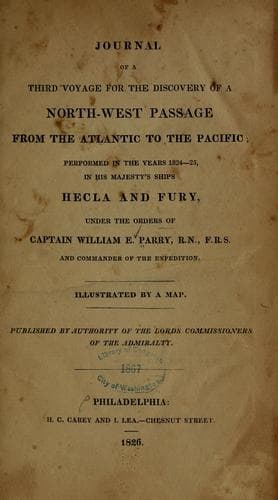
Journal of the Third Voyage for the Discovery of a North-West PassageParry, William Edward, Sir
History
Journal of the Third Voyage for the Discovery of a North-West Passage
Parry, William Edward, Sir
Arctic regions -- Discovery and exploration -- British; Fury (Ship); Hecla (Ship); Northwest Passage
Towards the end of June, the dovekies (_Colymbus Grylle_) were extremely
numerous in the cracks of the ice at the entrance of Port Bowen, and as
these were the only fresh supply of any consequence that we were able to
procure at this unproductive place, we were glad to permit the men to go
out occasionally with guns, after the ships were ready for sea, to obtain
for their messes this wholesome change of diet; while such excursions
also contributed essentially to their general health and cheerfulness.
Many hundreds of these birds were thus obtained in the course of a few
days. On the evening of the 6th of July, however, I was greatly shocked
at being informed by Captain Hoppner that John Cotterell, a seaman of the
_Fury_, had been found drowned in one of the cracks of the ice, by two
other men belonging to the same party who had been with him but a few
minutes before. We could never ascertain precisely in what manner this
accident happened, but it was supposed that he must have overreached
himself in stooping for a bird that he had killed. His remains were
committed to the earth on Sunday the 10th, with every solemnity which the
occasion demanded, and our situation would allow; and a tomb of stones
with a suitable inscription was afterwards erected over the grave.
In order to obtain oil for another winter’s consumption before the ships
could be released from the ice, and our travelling parties having seen a
number of black whales in the open water to the northward, two boats from
each ship were, with considerable labour, transported four miles along
shore in that direction, to be in readiness for killing a whale and
boiling the oil on the beach, whenever the open water should approach
sufficiently near. They took their station near a remarkable peninsular
piece of land on the south side of the entrance to Jackson’s Inlet, which
had on the former voyage been taken for an island. Notwithstanding these
preparations, however, it was vexatious to find that on the 9th of July
the water was still three miles distant from the boats, and at least
seven from Port Bowen. On the 12th, the ice in our neighbourhood began
to detach itself, and the boats under the command of Lieutenants Sherer
and Ross being launched on the following day, succeeded almost
immediately in killing a small whale of “five feet bone,” exactly
answering our purpose. Almost at the same time, and as it turned out
very opportunely, the ice at the mouth of our harbour detached itself at
an old crack, and drifted off, leaving only about one mile and a quarter
between us and the sea. Half of this distance being occupied by the
gravelled canal, which was dissolved quite through the ice in many parts
and had become very thin in all, every officer and man in both ships were
set to work without delay to commence a fresh canal from the open water,
to communicate with the other. This work proved heavier than we
expected, the ice being generally from five to eight feet, and in many
Public-domain text, read in full here on John Shaqi.
Reviews
Reviews
No reviews yet
Be the first to share your thoughts on this work.
Join the Discussion
Join the discussion
Sign in to leave a comment or review.
Sign InorCreate an account