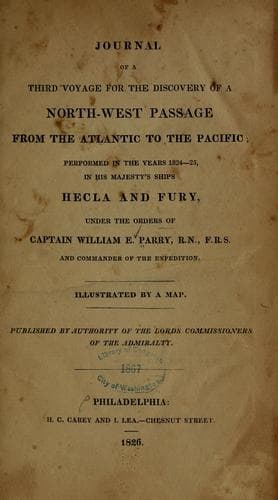
Journal of the Third Voyage for the Discovery of a North-West PassageParry, William Edward, Sir
History
Journal of the Third Voyage for the Discovery of a North-West Passage
Parry, William Edward, Sir
Arctic regions -- Discovery and exploration -- British; Fury (Ship); Hecla (Ship); Northwest Passage
After this we saw but one iceberg and one heavy loose piece previous to
our clearing Davis’s Strait.
On the 17th at noon we had passed to the southward of the Arctic Circle,
and from this latitude to that of about 58° we had favourable winds and
weather; but we remarked on this, as on several other occasions during
this season, that a northerly breeze, contrary to ordinary observation,
brought more moisture with it than any other. In the course of this run
we also observed more drift-wood than we had ever done before, which I
thought might possibly be owing to the very great prevalence of easterly
winds this season driving it further from the coast of Greenland than
usual. We saw very large flocks of kittiwakes, some of the whales called
finners, and, as we supposed, a few also of the black kind, together with
multitudes of porpoises.
On the morning of the 24th, notwithstanding the continuance of a
favourable breeze, we met, in the latitude of 58½°, so heavy a swell from
the north-eastward as to make the ship labour violently for
four-and-twenty hours. The northerly wind then dying away was succeeded
by a light air from the eastward with constant rain. A calm then
followed for several hours, causing the ship to roll heavily in the
hollow of the sea. On the morning of the 25th we had again an easterly
wind, which in a few hours reduced us to the close-reefed topsails and
reefed courses. At eight P.M. it freshened to a gale, which brought us
under the main-topsail and storm-staysails, and at seven the following
morning it increased to a gale of such violence from N.E.b.N. as does not
very often occur at sea in these latitudes. The gusts were at times so
tremendous as to set the sea quite in a foam, and threatened to tear the
sails out of the bolt-ropes. It abated a little for four hours in the
evening, but from nine P.M. till two the following morning blew with as
great violence as before, with a high sea, and very heavy rain;
constituting altogether as inclement weather as can well be conceived for
about eighteen hours. The wind gradually drew to the westward, with dry
weather, after the gale began to abate, and at six A.M. we were enabled
to bear up and run to the eastward with a strong gale at north-west.
Public-domain text, read in full here on John Shaqi.
Reviews
Reviews
No reviews yet
Be the first to share your thoughts on this work.
Elsewhere in the archive
Join the Discussion
Join the discussion
Sign in to leave a comment or review.
Sign InorCreate an account