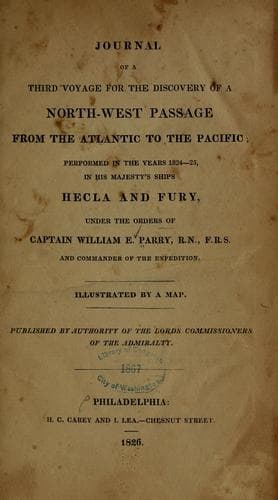
Journal of the Third Voyage for the Discovery of a North-West PassageParry, William Edward, Sir
History
Journal of the Third Voyage for the Discovery of a North-West Passage
Parry, William Edward, Sir
Arctic regions -- Discovery and exploration -- British; Fury (Ship); Hecla (Ship); Northwest Passage
As the whaling ships were not homeward bound, having as yet had
indifferent success in the fishery, I did not consider it necessary to
send despatches by them. After an hour’s communication with them, and
obtaining such information of a public nature as could not fail to be
highly interesting to us, we made sail to the southward: while we
observed them lying-to for some time after, probably to consult
respecting the unwelcome information with which we had furnished them as
to the whales, not one of which, by some extraordinary chance, we had
seen since leaving Neill’s Harbour. As this circumstance was entirely
new to us, it seems not unlikely that the whales are already beginning to
shift their ground, in consequence of the increased attacks which have
been made upon them of late years in that neighbourhood.
On the 10th we had an easterly wind, which, gradually freshening to a
gale, drew up the Strait from the southward, and blew strong for
twenty-four hours from that quarter. In the course of the night, and
while lying-to under the storm-sails, an iceberg was discovered, by its
white appearance, under our lee. The main-topsail being thrown aback we
were enabled to drop clear of this immense body, which would have been a
dangerous neighbour in a heavy seaway. The wind moderated on the 11th,
but on the following day another gale came on, which for nine or ten
hours blew in most tremendous gusts from the same quarter, and raised a
heavy sea. We happily came near no ice during the night, or it would
scarcely have been possible to keep the ship clear of it. It abated
after daylight on the 13th, but continued to blow an ordinary gale for
twelve hours longer. It was remarkable that the weather was extremely
clear overhead during the whole of this last gale, which is very unusual
here with a southerly wind. Being favoured with a northerly breeze on
the 15th we began to make some way to the southward. From nine A.M. to
one P.M. a change of temperature in the sea water took place from 37° to
33°. This circumstance seemed to indicate our approach to some ice
projecting to the eastward beyond the straight and regular margin of the
“pack,” which was at this time not in sight. The indication proved
correct and useful; for after passing several loose pieces of ice during
the night, on the morning of the 15th, just at daybreak, we came to a
considerable body of it, through which we continued to run to the
southward. We were now in latitude 68° 56′, and in longitude 58° 27′, in
which situation a great many bergs were in sight, and apparently aground.
We ran through this ice, which was very heavy, but loose and much broken
up, the whole day; when having sailed fifty-three miles S.S.E., and
appearances being the same as ever, we hauled to the E.S.E., to endeavour
to get clear before dark, which we were just enabled to effect after a
run of thirty miles in that direction, and then bore up to the southward.
Public-domain text, read in full here on John Shaqi.
Reviews
Reviews
No reviews yet
Be the first to share your thoughts on this work.
Elsewhere in the archive
Join the Discussion
Join the discussion
Sign in to leave a comment or review.
Sign InorCreate an account