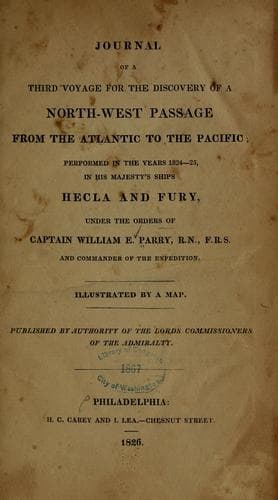
Journal of the Third Voyage for the Discovery of a North-West PassageParry, William Edward, Sir
History
Journal of the Third Voyage for the Discovery of a North-West Passage
Parry, William Edward, Sir
Arctic regions -- Discovery and exploration -- British; Fury (Ship); Hecla (Ship); Northwest Passage
The number of individuals composing the tribe of Esquimaux assembled at
Winter Island and Igloolik was two hundred and nineteen, of whom
sixty-nine were men, seventy-seven women, and seventy-three children.
Two or three of the men, from their appearance and infirmities, as well
as from the age of their children, must have been near seventy; the rest
were from twenty to about fifty. The majority of the women were
comparatively young, or from twenty to five-and-thirty, and three or four
only seemed to have reached sixty. Of the children, about one-third were
under four years old, and the rest from that age upwards to sixteen or
seventeen. Out of one hundred and fifty-five individuals who passed the
winter at Igloolik, we knew of eighteen deaths and of only nine births.
The stature of these people is much below that of Europeans in general.
One man, who was unusually tall, measured five feet ten inches, and the
shortest was only four feet eleven inches and a half. Of twenty
individuals of each sex measured at Igloolik, the range was:—
Men.—From 5 ft. 10 in. to 4 ft. 11 in. The average height, 5 ft. 5⅓ in.
Women.—From 5 ft. 3½ in. to 4 ft. 8¾ in. The average height, 5 ft. ½in.
The women, however, generally appear shorter than they really are, both
from the unwieldy nature of their clothes and from a habit, which they
early acquire, of stooping considerably forward in order to balance the
weight of the child they carry in their hood.
In their figure they are rather well-formed than otherwise. Their knees
are indeed rather large in proportion, but their legs are straight, and
the hands and feet, in both sexes, remarkably small. The younger
individuals were all plump, but none of them corpulent; the women
inclined the most to this last extreme, and their flesh was, even in the
youngest individuals, quite loose and without firmness.
Their faces are generally round and full, eyes small and black, nose also
small and sunk far in between the cheek bones, but not much flattened.
It is remarkable that one man, _Tē-ă_, his brother, his wife, and two
daughters had good Roman noses, and one of the latter was an extremely
pretty young woman. Their teeth are short, thick, and close, generally
regular, and in the young persons almost always white. The elderly women
were still well furnished in this way, though their teeth were usually a
good deal worn down, probably by the habit of chewing the seal-skins for
making boots.
Public-domain text, read in full here on John Shaqi.
Reviews
Reviews
No reviews yet
Be the first to share your thoughts on this work.
Elsewhere in the archive
Join the Discussion
Join the discussion
Sign in to leave a comment or review.
Sign InorCreate an account