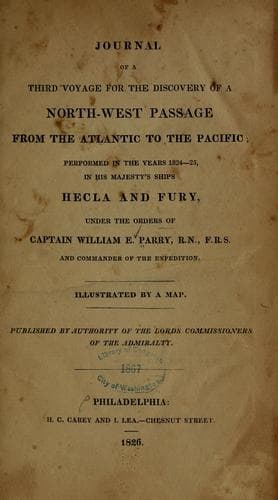
Journal of the Third Voyage for the Discovery of a North-West PassageParry, William Edward, Sir
History
Journal of the Third Voyage for the Discovery of a North-West Passage
Parry, William Edward, Sir
Arctic regions -- Discovery and exploration -- British; Fury (Ship); Hecla (Ship); Northwest Passage
In the young of both sexes the complexion is clear and transparent, and
the skin smooth. The colour of the latter, when divested of oil and
dirt, is scarcely a shade darker than that of a deep brunette, so that
the blood is plainly perceptible when it mounts into the cheeks. In the
old folks, whose faces were much wrinkled, the skin appears of a much
more dingy hue, the dirt being less easily, and therefore less
frequently, dislodged from them. Besides the smallness of their eyes,
there are two peculiarities in this feature common to almost all of them.
The first consists in the eye not being horizontal as with us, but coming
much lower at the end next the nose than at the other. Of the second an
account by Mr. Edwards will be given in another place.
By whatever peculiarities, however, they may in general be distinguished,
they are by no means ill-looking people; and there were among them three
or four grown-up persons of each sex who, when divested of their
skin-dresses, their tattooing, and, above all, of their dirt, might have
been considered pleasing-looking, if not handsome, people in any town in
Europe. This remark applies more generally to the children also; several
of whom had complexions nearly as fair as that of Europeans, and whose
little bright black eyes gave a fine expression to their countenances.
The hair both of males and females is black, glossy, and straight. The
men usually wear it rather long, and allow it to hang about their heads
in a loose and slovenly manner. A few of the younger men, and especially
those who had been about the shores of the _Welcome_, had it cut straight
upon the forehead, and two or three had a circular patch upon the crown
of the head, where the hair was quite short and thin, somewhat after the
manner of Capuchin friars. The women pride themselves extremely on the
length and thickness of their hair; and it was not without reluctance on
their part, and the same on that of their husbands, that they were
induced to dispose of any of it. When inclined to be neat they separate
their locks into two equal parts, one of which hangs on each side of
their heads and in front of their shoulders. To stiffen and bind these
they use a narrow strap of deerskin attached at one end to a round piece
of bone, fourteen inches long, tapered to a point, and covered over with
leather. This looks like a little whip, the handle of which is placed up
and down the hair, and the strap wound round it in a number of spiral
turns, making the tail thus equipped very much resemble one of those
formerly worn by our seamen. The strap of this article of dress, which
is altogether called a _tŏglēēgă_, is so made from the deerskin as to
show, when bound round the hair, alternate turns of white and dark fur,
which give it a very neat and ornamental appearance. On ordinary
occasions it is considered slovenly not to have the hair thus dressed,
and the neatest of the women never visited the ships without it. Those
Public-domain text, read in full here on John Shaqi.
Reviews
Reviews
No reviews yet
Be the first to share your thoughts on this work.
Elsewhere in the archive
Join the Discussion
Join the discussion
Sign in to leave a comment or review.
Sign InorCreate an account