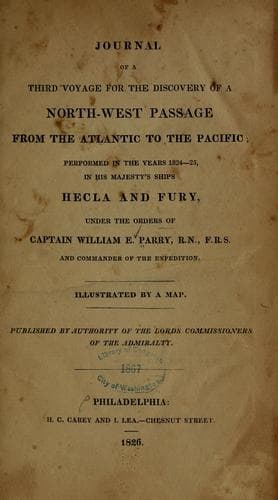
Journal of the Third Voyage for the Discovery of a North-West PassageParry, William Edward, Sir
History
Journal of the Third Voyage for the Discovery of a North-West Passage
Parry, William Edward, Sir
Arctic regions -- Discovery and exploration -- British; Fury (Ship); Hecla (Ship); Northwest Passage
When a seal is seen, the siatko is taken from a little leathern case, in
which, when out of use, it is carefully enclosed, and attached by its
socket to the point of the spear; in this situation it is retained by
bringing the allek tight down and fastening it round the middle of the
staff by what seamen call a “slippery hitch,” which may instantly be
disengaged by pulling on the other end of the line. As soon as the spear
has been thrown, and the animal struck, the siatko is thus purposely
separated; and being slung by the middle, now performs very effectually
the important office of a barb, by turning at right angles to the
direction in which it has entered the orifice. This device is in its
principle superior even to our barb; for the instant any strain is put
upon the line it acts like a toggle, opposing its length to a wound only
as wide as its own breadth.
The _āklĕak_, or _aklēēgă_, used for the large seal, has a blown bladder
attached to the staff, for the purpose of impeding the animal in the
water. The weapon with two long parallel prongs of bone or iron,
obtained from the natives of the Savage Islands, these people also called
_akleak_, and said it was for killing seals.
The third and largest weapon is that called _katteelik_, with which the
walrus and whale are attacked. The staff of this is not longer but much
stouter than that of the others, especially towards the middle, where
there is a small shoulder of ivory securely lashed to it for the thumb to
rest against, and thus to give additional force in throwing or thrusting
the spear. The ivory point of this weapon is made to fit into a socket
at the end of the staff, where it is secured by double thongs, in such a
manner as steadily to retain its position when a strain is put upon it in
the direction of its length, but immediately disengaging itself with a
sort of spring, when any lateral strain endangers its breaking. The
siatko is always used with this spear; and to the end of the allek, when
the animal pursued is in open water, they attach a whole seal-skin
(_hŏw-wūt-tă_), inflated like a bladder, for the purpose of tiring it out
in its progress through the water.
Public-domain text, read in full here on John Shaqi.
Reviews
Reviews
No reviews yet
Be the first to share your thoughts on this work.
Elsewhere in the archive
Join the Discussion
Join the discussion
Sign in to leave a comment or review.
Sign InorCreate an account