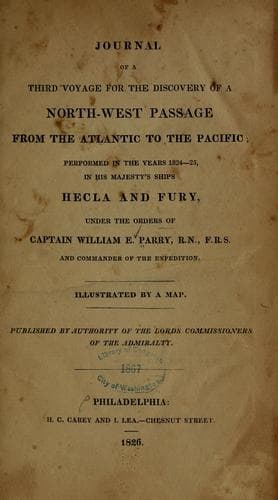
Journal of the Third Voyage for the Discovery of a North-West PassageParry, William Edward, Sir
History
Journal of the Third Voyage for the Discovery of a North-West Passage
Parry, William Edward, Sir
Arctic regions -- Discovery and exploration -- British; Fury (Ship); Hecla (Ship); Northwest Passage
In summer they rest their canoes upon two small stones raised four feet
from the ground; and in winter, on a similar structure of snow; in one
case to allow them to dry freely, and in the other to prevent the
snow-drift from covering, and the dogs from eating them. The difficulty
of procuring a canoe may be concluded from the circumstance of there
being at Winter Island twenty men able to manage one, and only seven
canoes among them. Of these indeed only three or four were in good
repair, the rest being wholly or in part stripped of the skin, of which a
good deal was occasionally cut off during the winter, to make boots,
shoes, and mittens for our people. We found no _oomiak_, or women’s
boat, among them, and understood that they were not in the habit of using
them, which may in part be accounted for by their passing so much of the
summer in the interior; they knew very well, however, what they were, and
made some clumsy models of them for our people.
In the weapons used for killing their game there is considerable variety,
according to the animal of which they are in pursuit. The most simple of
these is the _ōōnăk_, which they use only for killing the small seal. It
consists of a light staff of wood, four feet in length, having at one end
the point of a narwhal’s horn, from ten to eighteen inches long, firmly
secured by rivets and wooldings; at the other end is a smaller and less
effective point of the same kind. To prevent losing the ivory part in
case of the wood breaking, a stout thong runs along the whole length of
the wood, each end passing through a hole in the ivory, and the bight
secured in several places to the staff. In this weapon, as far as it has
yet been described, there is little art or ingenuity displayed; but a
considerable degree of both in an appendage called _siātkŏ_, consisting
of a piece of bone three inches long, and having a point of iron at one
end, and at the other end a small hole or socket to receive the point of
the oonak. Through the middle of this instrument is secured the _āllek_,
or line of thong, of which every man has, when sealing, a couple of
coils, each from four to six fathoms long, hanging at his back. These
are made of the skin of the _oguke_ as in Greenland, and are admirably
adapted to the purpose, both on account of their strength, and the
property which they possess of preserving their pliability even in the
most intense frost.
Public-domain text, read in full here on John Shaqi.
Reviews
Reviews
No reviews yet
Be the first to share your thoughts on this work.
Elsewhere in the archive
Join the Discussion
Join the discussion
Sign in to leave a comment or review.
Sign InorCreate an account