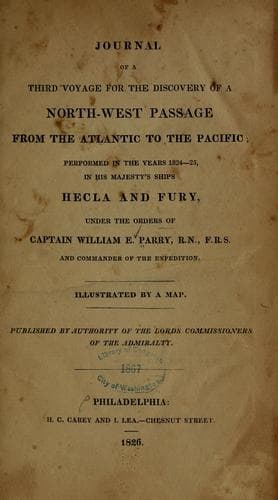
Journal of the Third Voyage for the Discovery of a North-West PassageParry, William Edward, Sir
History
Journal of the Third Voyage for the Discovery of a North-West Passage
Parry, William Edward, Sir
Arctic regions -- Discovery and exploration -- British; Fury (Ship); Hecla (Ship); Northwest Passage
One of the best of their bows was made of a single piece of fir, four
feet eight inches in length, flat on the inner side and rounded on the
outer, being five inches in girth about the middle, where, however, it is
strengthened on the concave side, when strung, by a piece of bone ten
inches long, firmly secured by tree-nails of the same material. At each
end of the bow is a knob of bone, or sometimes of wood covered with
leather, with a deep notch for the reception of the string. The only
wood which they can procure not possessing sufficient elasticity combined
with strength, they ingeniously remedy the defect by securing to the back
of the bow, and to the knobs at each end, a quantity of small lines, each
composed of a plait or “sinnet” of three sinews. The number of lines
thus reaching from end to end is generally about thirty; but besides
these, several others are fastened with hitches round the bow, in pairs,
commencing eight inches from one end, and again united at the same
distance from the other, making the whole number of strings, in the
middle of the bow sometimes amount to sixty. These being put on with the
bow somewhat bent the contrary way, produce a spring so strong as to
require considerable force as well as knack in stringing it and giving
the requisite velocity to the arrow. The bow is completed by a woolding
round the middle and a wedge or two, here and there, driven in to tighten
it. A bow in one piece is, however, very rare; they generally consist of
from two to five pieces of bone of unequal lengths, secured together by
rivets and tree-nails.
The arrows vary in length from twenty to thirty inches, according to the
materials that can be commanded. About two-thirds of the whole length is
of fir rounded, and the rest of bone let by a socket into the wood, and
having a head of thin iron, or more commonly of slate, secured into a
slit by two tree-nails. Towards the opposite end of the arrow are two
feathers, generally of the spotted oval, not very neatly lashed on. The
bow-string consists of from twelve to eighteen small lines of three-sinew
sinnet, having a loose twist, and with a separate becket of the same size
for going over the knobs at the end of the bow.
Public-domain text, read in full here on John Shaqi.
Reviews
Reviews
No reviews yet
Be the first to share your thoughts on this work.
Elsewhere in the archive
Join the Discussion
Join the discussion
Sign in to leave a comment or review.
Sign InorCreate an account