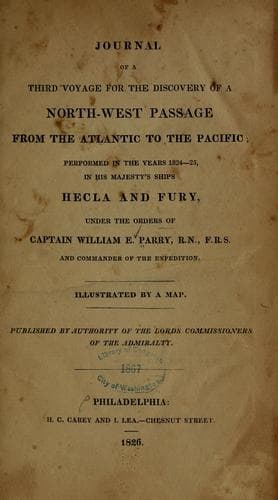
Journal of the Third Voyage for the Discovery of a North-West PassageParry, William Edward, Sir
History
Journal of the Third Voyage for the Discovery of a North-West Passage
Parry, William Edward, Sir
Arctic regions -- Discovery and exploration -- British; Fury (Ship); Hecla (Ship); Northwest Passage
We tried their skill in archery by getting them to shoot at a mark for a
prize, though with bows in extremely bad order, on account of the frost,
and their hands very cold. The mark was two of their spears stuck
upright in the snow, their breadth being three inches and a half. At
twenty yards they struck this every time; at thirty, sent the arrows
always within an inch or two of it; and at forty or fifty yards, I should
think, would generally hit a fawn if the animal stood still. These
weapons are perhaps sufficient to inflict a mortal wound at something
more than that distance, for which, however, a strong arm would be
required. The animals which they kill with the bow and arrow for their
subsistence are principally the musk-ox and deer, and less frequently the
bear, wolf, fox, hare, and some of the smaller animals.
It is a curious fact that the musk-ox is very rarely found to extend his
migrations to the eastward of a line passing through Repulse Bay, or
about the meridian of 86° west, while in a northern direction we know
that he travels as far as the seventy-sixth degree of latitude. In
Greenland this animal is known only by vague and exaggerated report; on
the western coast of Baffin’s Bay it has certainly been seen, though very
rarely, by the present inhabitants; and the eldest person belonging to
the Winter Island tribe had never seen one to the eastward of Eiwillik,
where, as well as at Akkōōleĕ, they are said to be numerous on the banks
of fresh-water lakes and streams. The few men who had been present at
the killing of one of these creatures seemed to pride themselves very
much upon it. Toolooak, who was about seventeen years of age, had never
seen either the musk-ox or the _kābleĕ-ārioo_, a proof that the latter
also is not common in this corner of America.
The reindeer are killed by the Esquimaux in great abundance in the summer
season, partly by driving them from islands or narrow necks of land into
the sea, and then spearing them from their canoes; and partly by shooting
them from behind heaps of stones raised for the purpose of watching them
and imitating their peculiar bellow or grunt. Among the various
artifices which they employ for this purpose, one of the most ingenious
consists in two men walking directly from the deer they wish to kill,
when the animal almost always follows them. As soon as they arrive at a
large stone, one of the men hides behind it with his bow, while the
other, continuing to walk on, soon leads the deer within range of his
companion’s arrows. They are also very careful to keep to leeward of the
deer, and will scarcely go out after them at all when the weather is
calm. For several weeks in the course of the summer some of these people
almost entirely give up their fishery on the coast, retiring to the banks
of lakes several miles in the interior, which they represent as large and
deep and abounding with salmon, while the pasture near them affords good
feeding to numerous herds of deer.
Public-domain text, read in full here on John Shaqi.
Reviews
Reviews
No reviews yet
Be the first to share your thoughts on this work.
Elsewhere in the archive
Join the Discussion
Join the discussion
Sign in to leave a comment or review.
Sign InorCreate an account