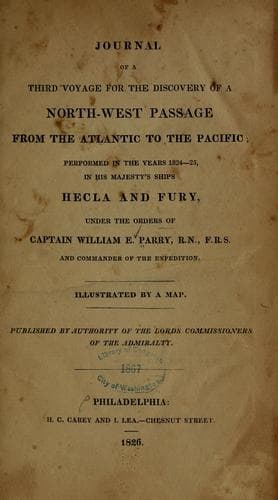
Journal of the Third Voyage for the Discovery of a North-West PassageParry, William Edward, Sir
History
Journal of the Third Voyage for the Discovery of a North-West Passage
Parry, William Edward, Sir
Arctic regions -- Discovery and exploration -- British; Fury (Ship); Hecla (Ship); Northwest Passage
Of the continental shore to the westward of Akkoolee, the Esquimaux
invariably disclaimed the slightest personal knowledge; for no land can
be seen in that direction from the hills. They entertain, however, a
confused idea that neither Esquimaux nor Indians could there subsist, for
want of food. Of the Indians they know enough by tradition to hold them
in considerable dread, on account of their cruel and ferocious manners.
When, on one occasion, we related the circumstances of the inhuman
massacre described by Hearne, they crowded round us in the hut, listening
with mute and almost breathless attention; and the mothers drew their
children closer to them, as if to guard them from the dreadful
catastrophe. It is worthy of notice that they call the Indians by a name
(_Eērt-kĕi-lĕe_), which appears evidently the same as that applied by the
Greenlanders to the man-eaters supposed to inhabit the eastern coast of
their country, and to whom terror has assigned a face like that of a dog.
The Esquimaux take some animals in traps, and by a very ingenious
contrivance of this kind they caught two wolves at Winter Island. It
consists of a small house built of ice, at one end of which a door, made
of the same plentiful material, is fitted to slide up and down in a
groove; to the upper part of this a line is attached, and, passing over
the roof, is let down into the trap at the inner end, and there held by
slipping an eye in the end of it over a peg of ice left for the purpose.
Over the peg, however, is previously placed a loose grummet, to which the
bait is fastened, and a false roof placed over all to hide the line. The
moment the animal drags at the bait the grummet slips off the peg,
bringing with it the line that held up the door, and this falling down
closes the trap and secures him.
A trap for birds is formed by building a house of snow just large enough
to contain one person, who closes himself up in it. On the top is left a
small aperture, through which the man thrusts one of his hands to secure
the bird the moment he alights to take away a bait of meat laid beside
it. It is principally gulls that are taken thus; and the boys sometimes
amuse themselves in this manner. A trap in which they catch foxes has
been mentioned in another place.
Public-domain text, read in full here on John Shaqi.
Reviews
Reviews
No reviews yet
Be the first to share your thoughts on this work.
Elsewhere in the archive
Join the Discussion
Join the discussion
Sign in to leave a comment or review.
Sign InorCreate an account