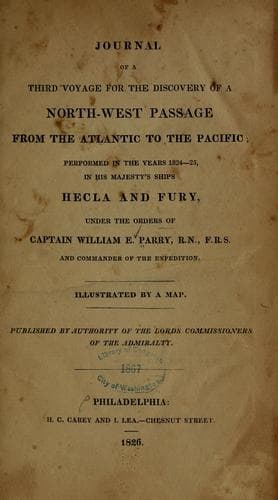
Journal of the Third Voyage for the Discovery of a North-West PassageParry, William Edward, Sir
History
Journal of the Third Voyage for the Discovery of a North-West Passage
Parry, William Edward, Sir
Arctic regions -- Discovery and exploration -- British; Fury (Ship); Hecla (Ship); Northwest Passage
The sledges belonging to these Esquimaux were in general large and
heavily constructed, being more adapted to the carriage of considerable
burdens than to very quick travelling. They varied in size, being from
six and a half to nine feet in length, and from eighteen inches to two
feet in breadth. Some of those at Igloolik were of larger dimensions,
one being eleven feet in length, and weighing two hundred and sixty-eight
pounds, and two or three others above two hundred pounds. The runners
are sometimes made of the right and left jaw-bones of a whale; but more
commonly of several pieces of wood or bone scarfed and lashed together,
the interstices being filled, to make all smooth and firm, with moss
stuffed in tight, and then cemented by throwing water to freeze upon it.
The lower part of the runner is shod with a plate of harder bone, coated
with fresh-water ice to make it run smoothly and to avoid wear and tear,
both which purposes are thus completely answered. This coating is
performed with a mixture of snow and fresh water about half an inch
thick, rubbed over it till it is quite smooth and hard upon the surface,
and this is usually done a few minutes before setting out on a journey.
When the ice is only in part worn off, it is renewed by taking some water
into the mouth, and spirting it over the former coating. We noticed a
sledge which was extremely curious, on account of one of the runners and
a part of the other being constructed without the assistance of wood,
iron, or bone of any kind. For this purpose a number of seal-skins being
rolled up and disposed into the requisite shape, an outer coat of the
same kind was sewed tightly round them; this formed the upper half of the
runner, the lower part of which consisted entirely of moss moulded while
wet into the proper form, and being left to freeze, adhering firmly
together and to the skins. The usual shoeing of smooth ice beneath
completed the runner, which for more than six months out of twelve, in
this climate, was nearly as hard as any wood; and for winter use no way
inferior to those constructed of more durable materials. The crosspieces
which form the bottom of the sledge are made of bone, wood, or anything
they can muster. Over these is generally laid a seal-skin as a flooring,
and in the summertime a pair of deer’s horns are attached to the sledge
as a back, which in the winter are removed to enable them when stopping
to turn the sledge up, so as to prevent the dogs running away with it.
The whole is secured by lashings of thong, giving it a degree of strength
combined with flexibility which perhaps no other mode of fastening could
effect.
Public-domain text, read in full here on John Shaqi.
Reviews
Reviews
No reviews yet
Be the first to share your thoughts on this work.
Elsewhere in the archive
Join the Discussion
Join the discussion
Sign in to leave a comment or review.
Sign InorCreate an account