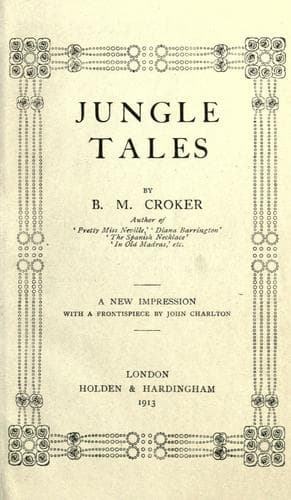
British -- India -- Fiction; India -- History -- British occupation, 1765-1947 -- Fiction; Short stories
A DOG TRAGEDY.
When the Royal British Skirmishers were quartered in Bombay, their
second in command was Major Bowen, a spare, grizzled, self-contained
little soldier, who lived alone in one of those thatched bungalows
that resemble so many monstrous mushrooms, bordering the racecourse.
“The Major,” as he was called _par excellence_, was best described by
negatives. He was not married. He was not a ladies’ man. Nor was he
a sportsman; nor handsome, young, rich, nor even clever--in short,
he was not remarkable for anything except, perhaps, his dog. No one
could dispute the fact that Major Bowen was the owner of an uncommon
animal. He and this dog had exchanged into “the Skirmishers” from
another regiment six years previously, and though the pair were at
first but coldly received, they adapted themselves so admirably to
their new surroundings that ere long they had gained the esteem and
goodwill of both rank and file; and, as time wore on, there actually
arose an ill-concealed jealousy of their old corps, and a disposition
to ignore the fact that they had not always been part and parcel of
the gallant Skirmishers. Although poor, and having but little besides
his pay, the Major was liberal--both just and generous; and if he was
mean or close-fisted with any one, that person’s name was Reginald
Bowen. He had an extremely lofty standard of honour and of the value of
his lightest word. He gave a good tone to the mess, and though he was
strict with the youngsters, they all liked him. Inflexible as he could
look on parade or in the orderly-room, elsewhere he received half the
confidences of the regiment; and many a subaltern had been extricated
from a scrape, thanks to the little Major’s assistance--monetary and
otherwise. He was a smart officer and a capital horseman, and here was
another source of his popularity. He lent his horses and ponies, with
ungrudging good faith, to those impecunious youths who boasted but
the one hard-worked barrack “tat;” and many a happy hour with hounds,
or on the polo-ground, was spent on the back of the Major’s cattle.
Major Bowen did not race or hunt, and rarely played polo; in fact, he
was not much interested in anything--although upwards of forty, he was
supremely indifferent to his dinner!--the one thing he really cared
about was his _dog_: a sharp, well-bred fox-terrier, with bright eyes
and lemon-coloured ears,--who, in spite of the fact that her original
name was “Minnie,” had been known as “the Missus” for the last five
years. This name was given to her in joke, and in acknowledgment of her
accomplishments; the agreeable manner in which she did the honours of
her master’s bungalow, and the extraordinary care she took of him, and
all his property. It was truly absurd to see this little creature--of
at most sixteen pounds’ weight--gravely lying, with crossed paws, in
front of the Major’s sixteen hands “waler,” whilst he was going round
barracks, or occupied in the orderly-room. Her pose of self-importance
Public-domain text, read in full here on John Shaqi.
Reviews
Reviews
No reviews yet
Be the first to share your thoughts on this work.
Join the Discussion
Join the discussion
Sign in to leave a comment or review.
Sign InorCreate an account