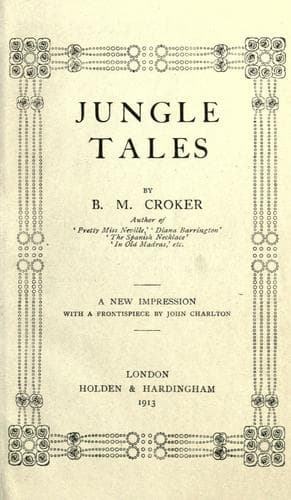
British -- India -- Fiction; India -- History -- British occupation, 1765-1947 -- Fiction; Short stories
“I can,” said Tom, emphatically. “He looks what he is--an unmitigated
scoundrel, and a miser. Did you notice how close his eyes were
together? He is a rich man, too; is lord of the soil as far as your
eyes can see. His grandfather owned a great deal more before the
Mutiny, but it was shorn from him, and he was thankful to be left with
an acre--or his life.”
“Why?” asked Charlie and I in a breath.
“He came out of that bad business very badly. When the inhabitants of
Luckmee were surprised, they sent their women and children to him for
protection, he being, as they supposed, their very good friend; but
he simply bundled them all out, and they were every one massacred. The
rajah then believed that the mutineers would carry everything before
them, but after the fall of Delhi he changed his tune, and sent on a
charger the head of the chief leader in these parts--his own nephew,
as it happened, but this is a detail--in order to make his peace. Of
course, he saved his skin, but he had a bad record, and his grandson is
a chip of the old block.”
“Who told you all this?” I inquired.
“The collector. He says this man grinds down the ryots shamelessly, and
does many a queer thing that ought to land him in a court of law. Here
is the forest, and here, thank goodness, is _the_ bungalow at last.”
Our halting-place proved to be a thatched stone cottage, containing
three rooms, and bath-rooms; there was a deep verandah all round,
excellent servants’ quarters and stables--in short, it was the beau
idéal of a jungle residence. One verandah looked towards the forest,
with its cool, dark recesses, the other commanded the river, and beyond
it, faintly on the sky line, glimmered the snows.
The bungalow was surrounded by about twenty acres of park-like pasture,
through which ran a public road leading to a fine bridge. We took in
these details as we lounged about in the moonlight after dinner, and
unanimously agreed that our present quarters were quite perfect in
every respect.
The next day we fished--a nice, lazy, unexciting occupation. I
sauntered home early in the afternoon--not being a particularly
enthusiastic angler--and disposed myself in a comfortable deep straw
chair in the verandah, in order to enjoy a novel and what I considered
a well-earned cup of tea. As I reclined at my ease, devouring fiction
and cake, sandwich fashion, my attention was arrested by a sound of
loud crashing and smashing of branches in the usually death-like
stillness of the forest. I sat erect, gazing intently at the violent
storm among the leaves, expecting to see emerge a deer, a pig, or, at
the very worst, a peacock! But after staring steadily for some time, I
found that I was looking at the back of a remarkably tall elephant.
The ayah, who was also watching, pointed and called out, “Hathi, mem
sahib, burra hathi,” as if I did not know an elephant when I saw one!
Public-domain text, read in full here on John Shaqi.
Reviews
Reviews
No reviews yet
Be the first to share your thoughts on this work.
Join the Discussion
Join the discussion
Sign in to leave a comment or review.
Sign InorCreate an account