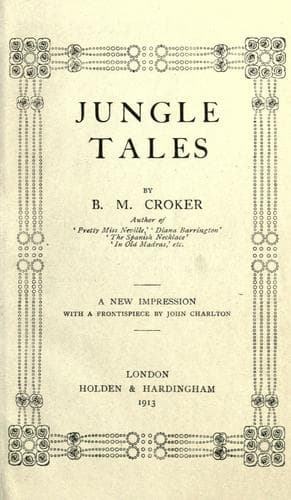
British -- India -- Fiction; India -- History -- British occupation, 1765-1947 -- Fiction; Short stories
The day before Christmas we started in the highest spirits. Algy wore a
serviceable shikar suit, strong blue putties, and shooting-boots, and
looked as workmanlike as possible. Our destination, Karwassa, lay sixty
miles due north, and we travelled forty-five miles along the smooth
trunk road in a dogcart, with relays of horses, and arrived early in
the afternoon at Munser Dâk Bungalow--a neat white building, in a
neat little compound, that was almost swallowed up by the surrounding
jungle. Here we experienced our first breakdown. Jones prided himself
on doing everything on a “system”--but the system failed ignominiously.
Our luggage and servants were fifteen miles behind, and we could not
proceed that night, so we resigned ourselves into the hands of the
Dâk bungalow khansamah, who slew the usual Dâk bungalow dinner for
our behoof. There was a fair going on in the village, and we strolled
across to inspect it. A fair of the kind was no novelty to me; but
Algy was childishly delighted with all he witnessed, and stood gazing
in profound amazement at the stalls of Huka heads, pewter anklets,
bangles, and coarse, bright native cloths for turbans and sarees; the
money was chiefly copper pice and cowrie shells--the shell currency
was a complete revelation to our Londoner, as was a tangle-haired,
ash-bedaubed fakir, with his head thrust through a square iron frame,
so devised that rest was impossible. He could never lean back, never
lie down, never know ease. He had worn this instrument of torture for
twelve years, and was a most holy man--so Nuddoo, the shikari, informed
us.
“But what is the good of it?” demanded Algy. “What the dickens does he
do it for?”
“For a vow,” was the solemn reply.
“I’d rather be dead than have to wear an iron gate round my neck,”
rejoined Algy. “But I suppose he thinks he is doing the right thing,
and probably he is a good sort.”
And he gave the good sort five rupees.
Next morning we started in real earnest, for the real jungle--each on
a separate little cart or chukrun, drawn by a pair of small trotting
bullocks; the driver rode on the pole, and behind him there was just
room for one person, if he curled himself up, and sat cross-legged. We
formed quite a long procession, as we passed down the village street,
and all the population came out to speed the sahibs, “who were going
to try and shoot the Karwassa man-eater.” Judging by their looks, they
were by no means sanguine of our success.
Public-domain text, read in full here on John Shaqi.
Reviews
Reviews
No reviews yet
Be the first to share your thoughts on this work.
Join the Discussion
Join the discussion
Sign in to leave a comment or review.
Sign InorCreate an account