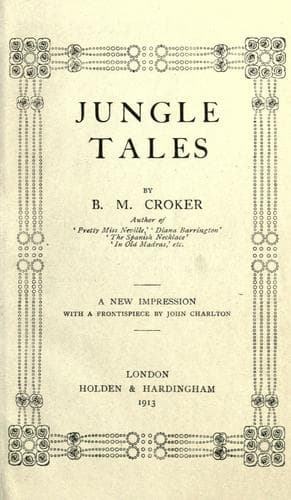
British -- India -- Fiction; India -- History -- British occupation, 1765-1947 -- Fiction; Short stories
Zālim Sing had a presentiment that his good days were leaving him when
he saw his friend Goora Dutt and four other men led away between the
crops, with handcuffs on their wrists; and many a curious glance was
cast at Zālim himself.
“How came his wife to wear a pearl nose-ring? How came he to possess
_four_ bullocks and a Waterbury watch and a pistol? Could any one give
an honest reason? Could his crops have sold at double the rates of
ours?” his neighbours asked one another. Truly, he was as great a thief
as any; but his accomplices had been staunch to him, and had held their
peace.
Of course Chūnnee was released, much to his own surprise. His ragged
coat was restored to him one morning, with a “hookum,” to say that he
was free. His first duty was to return thanks to the benevolent lady
who had rescued his starving children. He laid his head at her feet,
and touched the hem of her gown; and there was a mist in his eyes as
he said, “Now I understand why God suffered me to be put in the Jail
Khana. It was that my children might know you. Eshwar, Eshwar will
bless you always.”
“And where will you go, Chūnnee?” she inquired, ere he took leave.
“Home,” he answered: a native returns to his ancestral village as a
Swiss turns to the mountains. “Back to Paroor and my house. It is true
that I have no friends; but I have no friends anywhere. I was born
there; also my father and grandfather. It is my country, and there will
I die.”
“It is more to the purpose, how will you live, once you are there?”
“I have good-conduct money. I shall hire a little bit of land, and dig
it, and buy seeds. Girunda is growing big, he can help me.”
He was not to be deterred by offers of employment in the city. No, his
heart was set upon Paroor--only Paroor; and his kind patroness fitted
out the children with clothes and food, and they bade farewell to her,
and her enchanted garden, with many bitter tears.
Most of the journey was made by rail, and in the delightful novelty of
the motion of a railway carriage they soon forgot their sorrows. The
last twenty miles had to be accomplished on foot. Girunda stepped out
manfully beside his father, who carried Gyannia. All _he_ had to carry
was the cat; and, moreover, he had now a pair of shoes and a stick.
They reached Paroor at nightfall, and Chūnnee went straight to his own
hut. It was occupied by an old crone, who had bought it from Zālim Sing
for six rupees, and who felt herself a proprietress of some importance.
She thrust him out with a lighted brand, and Chūnnee and his family
passed the night under a stack of straw.
The following morning he went and rapped boldly at his brother’s door,
and confronted him sternly.
“So thou art back, badmash! I wonder thou hast come here!” cried Zālim,
with ill-simulated scorn.
“How daredst thou sell my house?” rejoined the other.
“I sold it to pay for thy children’s food.”
Public-domain text, read in full here on John Shaqi.
Reviews
Reviews
No reviews yet
Be the first to share your thoughts on this work.
Elsewhere in the archive
Join the Discussion
Join the discussion
Sign in to leave a comment or review.
Sign InorCreate an account