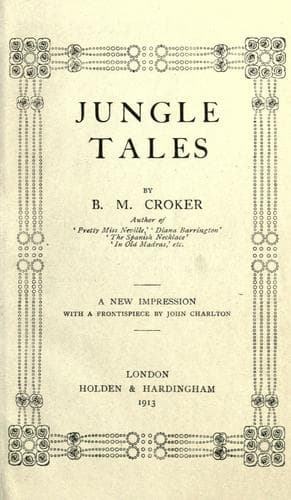
British -- India -- Fiction; India -- History -- British occupation, 1765-1947 -- Fiction; Short stories
“Speak not of the children you worked as slaves, and beat, and turned
out at night to perish. Restore the money and the house, O villain!”
Hearing loud and angry voices, the inevitable crowd collected. There
was Chūnnee, looking quite well-to-do, and actually speaking in a
commanding tone to his once all-powerful brother!
“Behold, he hath sold my poor hovel, and hath kept the money,”
explained Chūnnee, turning to the eager audience. “He hath beaten and
starved my children, and hath thrust them out to die. Why do ye suffer
such a sinner among you?”
The crowd began to clamour and howl, and Zālim Sing withdrew and barred
his door; but the angry neighbours beat upon it till it shook on its
rusty hinges, and Zālim Sing was forced to shout, “Go! thou shalt have
thy house, O badmash.” And for the first time in all his life, Chūnnee
was beholden to the force of public opinion.
CHAPTER VI.
Old Turroo had heard of Chūnnee’s arrival. Everything is known in
a short time in a small community, save such matters as robbery and
gambling, practised under the cover of darkness.
He sent for his grand-nephew--much to that grand-nephew’s surprise--and
beckoning him in with a long, claw-like finger, commanded him to close
the door, and be seated on a charpoy. He then pushed his huka towards
him, and coughed, and said--
“Thou art back, and I have much to say unto thee. How dost thou mean to
live, and keep thy children, O Chūnnee Sing?”
“I hope to hire that plot of land near Ram Lall’s garden, and till it
by hand, and sow it with cotton, jawarri, and dál. I have recovered my
house which Zālim Sing sold.”
“Wouldst thou leave that dog-kennel, and come and abide here with me?”
“Here--with thee!” he echoed incredulously; he could not believe his
ears.
“Yea. Hearken to me, Chūnnee, the son of Duloo Sing. It is in my mind
to make thee mine heir. Thou hast suffered wrongfully for my treasure;
it shall be thine one day.”
“I did not take the money or jewels, it is true, O Turroo Sing, but
it is true that I desired to steal them--not from love of lucre and
gold, or the vice of robbery, but for the sake of my children, who were
perishing. All that day the little ones tasted naught but cow’s food.
The boy asked thee for a few cowries, and thou gavest him blows; and
an evil spirit tempted me as I walked in the fields at even, and said
in mine ear, ‘Turroo is rich--yea, very rich. He hath a house and land
and cattle, and warm bedding, and brass cooking-pots, and a store
of grain laid up in his granary for many seasons. Moreover, he hath
a great treasure buried beneath his floor, which is of no profit to
him, save to handle and to count. Behold, some of this useless silver
will feed my children and me. I will dig through the wall, and steal,
under the cover of darkness. The man is old; he sleeps fast. I shall
take one hundred rupees, and be happy.’ But I failed, as thou knowest.
Nevertheless, I was guilty.”
Public-domain text, read in full here on John Shaqi.
Reviews
Reviews
No reviews yet
Be the first to share your thoughts on this work.
Elsewhere in the archive
Join the Discussion
Join the discussion
Sign in to leave a comment or review.
Sign InorCreate an account