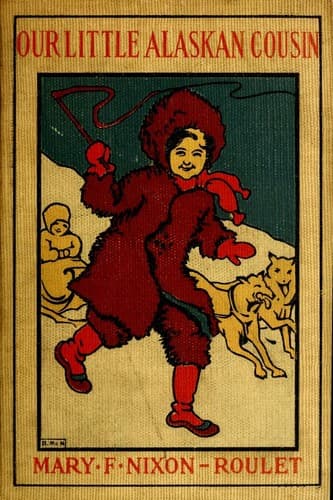
Kalitan, Our Little Alaskan CousinNixon-Roulet, Mary F.
General
Kalitan, Our Little Alaskan Cousin
Nixon-Roulet, Mary F.
Children -- Alaska -- Juvenile literature
"You see, Teddy, it was this way. A great many years ago, about 1740, a
Danish sailor named Bering, who was in the service of the Russians,
sailed across the ocean and discovered the strait named for him, and a
number of islands. Some of these were not inhabited, others had Indians
or Esquimos on them, but, after the manner of the early discoverers,
Bering took possession of them all in the name of the Emperor of
Russia. It doesn't seem right as we look at things now, but in those
days 'might made right,' and it was just the same way the English did
when they came to America.
"The Russians settled here, finding the fishing and furs fine things for
trade, and driving the Indians, who would not yield to them, farther and
farther inland. In 1790 the Czar made Alexander Baranoff manager of the
trading company. Baranoff established trading-posts in various places,
and settled at Sitka, where you can see the ruins of the splendid castle
he built. The Russians also sent missionaries to convert the Indians to
the Greek Church, which is the church of Russia. The Indians, however,
never learned to care for the Russians, and often were cruelly treated
by them. The Russians, however, tried to do something for their
education, and established several schools. One as early as 1775, on
Kadiak Island, had thirty pupils, who studied arithmetic, reading,
navigation, and four of the mechanical trades, and this is a better
record than the American purchasers can show, I am sorry to say.
"One of the recent travellers[6] in Alaska says that he met in the
country 'American citizens who never in their lives heard a prayer for
the President of the United States, nor of the Fourth of July, nor the
name of the capital of the nation, but who have been taught to pray for
the Emperor of Russia, to celebrate his birthday, and to commemorate the
victories of ancient Greece.' In March, 1867, the Russians sold Alaska
to the United States for $7,200,000 in gold. It was bought for a song
almost, when we consider the immense amount of money made for the
government by the seal fisheries, the cod and salmon industries, and
the opening of the gold fields. The resources of the country are not
half-known, and the government is beginning to see this. That is one of
the reasons they have sent me here, with the other men, to find out what
the earth holds for those who do not know how to look for its treasures.
Gold is not the best thing the earth produces. There is land in Alaska
little known full of coal and other useful minerals. Other land is
covered with magnificent timber which could be shipped to all parts of
the world. There are pasture-lands where stock will fatten like pigs
without any other feeding; there are fertile soils which will raise
almost any crops, and there are intelligent Indians who can be taught to
work and be useful members of society. I do not mean dragged off to the
United States to learn things they could never use in their home lives,
Public-domain text, read in full here on John Shaqi.
Reviews
Reviews
No reviews yet
Be the first to share your thoughts on this work.
Join the Discussion
Join the discussion
Sign in to leave a comment or review.
Sign InorCreate an account