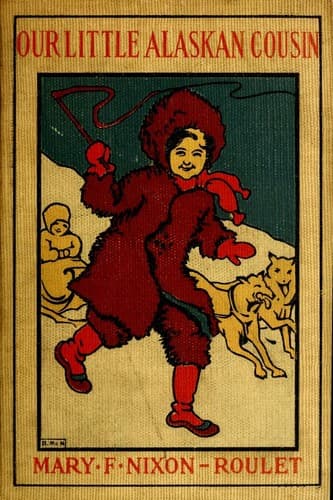
Kalitan, Our Little Alaskan CousinNixon-Roulet, Mary F.
General
Kalitan, Our Little Alaskan Cousin
Nixon-Roulet, Mary F.
Children -- Alaska -- Juvenile literature
"My home," said Kalitan, pointing to the largest house, "my people."
There was a great deal of pride in his tone and look, and he received a
warm welcome as the canoes touched land and their occupants sprang on
shore. The boys crowded around the young Indian and chattered and
gesticulated toward Ted, while a bright-looking little Malamute sprang
upon Kalitan and nearly knocked him down, covering his face with eager
puppy kisses.
The girls were less boisterous, and regarded Teddy with shy curiosity.
Some of them were quite pretty, and the babies were as cunning as the
puppies. They barked every time the dogs did, in a funny, hoarse little
way, and, indeed, Alaskan babies learn to bark long before they learn to
talk.
The Tyee's wife received Teddy kindly, and he soon found himself
quite at home among these hospitable people, who seemed always friendly
and natural. Nearly all spoke some English, and he rapidly added to his
store of Chinook, so that he had no trouble in making himself understood
or in understanding. Of course he missed his father, but he had little
time to be lonely. Life in the village was anything but uneventful.
At first there was the whale to be attended to, and all the village
turned out for that. The huge creature had drifted ashore on the farther
side of the island, and Ted was much interested in seeing him gradually
disposed of. Great masses of blubber were stripped from the sides to be
used later both for food and fuel, the whalebone was carefully secured
to be sold to the traders, and it seemed to Ted that there was not one
thing in that vast carcass for which the Indians did not have some use.
Ted soon tired of watching the many things done with the whale, but
there was plenty to do and see in the village.
The village houses were all alike. There was one large room in which the
people cooked, ate, and slept. The girls had blankets strung across one
corner, behind which were their beds. Teddy was given one also for his
corner of the great room in the Tyee's house.
He learned to eat the food and to like it very much. There was dried
fish, herons' eggs, berries, or those put up in seal oil, which is
obtained by frying the fat out of the blubber of the seal. The Alaskans
use this oil in nearly all their cooking, and are very fond of it. Ted
ate also dried seaweed, chopped and boiled in seal oil, which tasted
very much like boiled and salted leather, but he liked it very well.
Indeed he grew so strong and well, out-of-doors all day in the clear air
and bright sunshine of the Alaskan June, that he could eat anything and
tramp all day without being too tired to sleep like a top all night,
and wake ready for a new day with a zest he never felt at home.
Fresh fish were plentiful. The boys caught salmon, smelts, and
whitefish, and many were dried for the coming winter, while clams,
gum-boots, sea-cucumbers, and devil-fish, found on the rocks of the
shore, were every-day diet.
Public-domain text, read in full here on John Shaqi.
Reviews
Reviews
No reviews yet
Be the first to share your thoughts on this work.
Join the Discussion
Join the discussion
Sign in to leave a comment or review.
Sign InorCreate an account