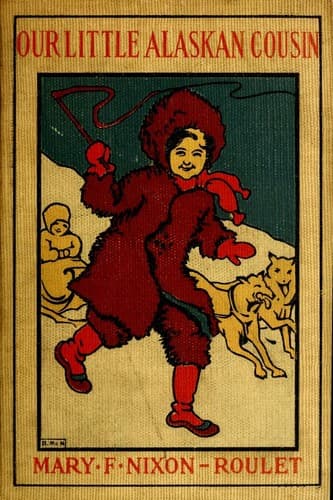
Kalitan, Our Little Alaskan CousinNixon-Roulet, Mary F.
General
Kalitan, Our Little Alaskan Cousin
Nixon-Roulet, Mary F.
Children -- Alaska -- Juvenile literature
"When, therefore, the people of his tribe found the bodies of
Kitt-a-youx and her child among the kelp, having heard of her love for
Zampa, they bore them to the same cave, and, wrapping them in furs, they
placed Kitt-a-youx beside her beloved husband, and in her burial she
found her home and felt the kindness of the Great Spirit. This, then, is
the story of the burial cave of Kagamil, and since that day no man dwelt
upon the island, and it is known as the 'island of the dead.'"
"I'd like to see it, I can tell you," said Ted. "Are there any burial
caves around here?"
"The Thlinkits do not bury in caves," said Tanana. "We used to burn our
dead, but often we place them in totem-poles."
"I thought those great poles by your doors were totems," said Ted,
puzzled.
"Yes," said the girl. "They are caste totems, and all who are of any
rank have them. As we belong to the Raven, or Bear, or Eagle clan, we
have the carved poles to show our rank, but the totem of the dead is
quite different. It does not stand beside the door, but far away. It is
alone, as the soul of the dead in whose honour it is made. It is but
little carved. A square hole is cut at the back of the pole, and the
body of the dead, wrapped in a matting of cedar bark, is placed within,
a board being nailed so that the body will not fall to the ground. A
potlatch is given, and food from the feast is put in the fire for the
dead person."
"It seems queer to put weapons and blankets and things to eat on
people's graves," said Ted. "Why do they do it?"
"Of the dead we know nothing," said Tanana. "Perhaps the warrior spirit
wishes his arrows in the Land of the Great Unknown."
"Yes, but he can't come back for them," persisted Ted.
"At Wrangel, Boston man put flowers on his girl's grave," said Kalitan,
drily. "She come back and smell posy?"
Having no answer ready, Ted changed the subject and asked:
"Why do you have the raven at the top of your totem pole?"
"Indian cannot marry same totem," said Kalitan. "My father was eagle
totem, my mother was raven totem. He carve her totem at the top of the
pole, then his totem and those of the family are carved below. The
greater the family the taller the totem."
"How do you get these totems?" demanded Ted.
"Clan totems we take from our parents, but a man may choose his own
totem. Before he becomes a man he must go alone into the forest to
fast, and there he chooses his totem, and he is brother to that animal
all his life, and may not kill it. When he comes forth, he may take part
in all the ceremonies of his tribe."
"Why, it is something like knighthood and the vigil at arms and
escutcheons, and all those Round-Table things," exclaimed Ted, in
delight, for he dearly loved the stirring tales of King Arthur and his
knights and the doughty deeds of Camelot.
"Tell us about that," said Kalitan, so Ted told them many tales in the
moonlight, as they sat beneath the shadows of the quaint and curious
totem-poles of Kalitan's tribe.
FOOTNOTES:
Public-domain text, read in full here on John Shaqi.
Reviews
Reviews
No reviews yet
Be the first to share your thoughts on this work.
Join the Discussion
Join the discussion
Sign in to leave a comment or review.
Sign InorCreate an account