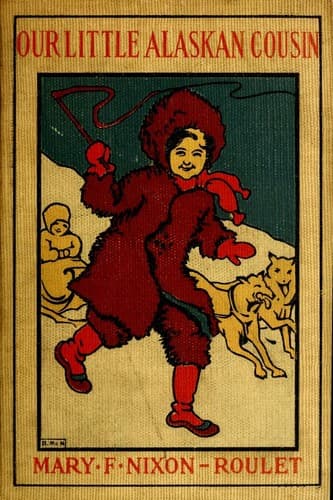
Kalitan, Our Little Alaskan CousinNixon-Roulet, Mary F.
General
Kalitan, Our Little Alaskan Cousin
Nixon-Roulet, Mary F.
Children -- Alaska -- Juvenile literature
"Very well, indeed," said his father. "At first about two hundred
animals were brought over, and they increased about fifty per cent. the
first year. Everywhere in the arctic region the _tundra_ gives the
reindeer the moss he lives on. It is never dry in summer because the
frost prevents any underground drainage, and even in winter the animals
feed upon it and thrive. There are, it is said, hundreds of thousands of
square miles of reindeer moss in Alaska, and reindeer stations have been
established in many places, and, as the natives are the only ones
allowed to raise them, it seems as if this might be the way found to
help the industrious Esquimos to help themselves."
"But if it all belongs to the government, how can it help the natives?"
asked Ted.
"Of course they have to be taught the business," said Mr. Strong. "The
government brought over some Lapps and Finlanders to care for the deer
at first, and these took young Esquimos to train. Each one serves five
years as herder, having a certain number of deer set apart for him each
year, and at the end of his service goes into business for himself."
"Why, I think that's fine," cried Ted. "Oh, Daddy, what is that? It
looks like a queer, tangled up forest, all bare branches in the
summer."
"That's a reindeer herd lying down for their noonday rest. What you see
are their antlers. How would you like to be in the midst of that forest
of branches?" asked Mr. Strong.
"No, thank you," said Teddy, but Kalitan said:
"Reindeer very gentle; they will not hurt unless very much frightened."
"What queer-looking animals they are," said Ted, as they approached
nearer. "A sort of a cross between a deer and a cow."
"Perhaps they are more useful than handsome, but I think there is
something picturesque about them, especially when hitched to sleds and
skimming over the frozen ground."
The farm at Teller was certainly an interesting spot. Teddy saw the deer
fed and milked, the Lapland women being experts in that line, and found
the herders, in their quaint _parkas_ tied around the waist, and
conical caps, scarcely less interesting than the deer. Two funny little
Lapp babies he took to ride on a large reindeer, which proceeding did
not frighten the babies half so much as did the white boy who put them
on the deer. A reindeer was to them an every-day occurrence, but a
Boston boy was quite another matter.
[Illustration: "TWO FUNNY LITTLE LAPP BABIES HE TOOK TO RIDE ON A LARGE
REINDEER."]
Better than the reindeer, however, Teddy and Kalitan liked the draught
dogs who hauled the water at the station. A great cask on wheels was
pulled by five magnificent dogs, beautiful fellows with bright alert
faces.
Public-domain text, read in full here on John Shaqi.
Reviews
Reviews
No reviews yet
Be the first to share your thoughts on this work.
Join the Discussion
Join the discussion
Sign in to leave a comment or review.
Sign InorCreate an account