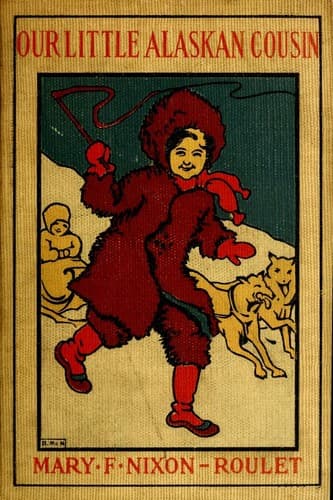
Kalitan, Our Little Alaskan CousinNixon-Roulet, Mary F.
General
Kalitan, Our Little Alaskan Cousin
Nixon-Roulet, Mary F.
Children -- Alaska -- Juvenile literature
"My story is of the far, far north. Beside a salmon stream there dwelt
people rich in slaves. These caught and dried the salmon for the winter,
and nothing is better to eat than dried salmon dipped in seal oil. All
the fish were caught and stored away, when lo! the whiteness fell from
heaven and the snows were upon them. It was the time of snow and they
should not have complained, but the chief was evil and he cursed the
whiteness. No one should dare to speak evil of the Snow Spirit, which
comes from the Unknown! Deeper and deeper grew the snow. It flew like
feathers about the _eglu_,[5] and the slaves had many troubles in
putting in limbs for the fire. Then the snow came in flakes so large
they seemed like the wings of birds, and the house was covered, and they
could no longer keep their _kyaks_ on top of the snow. All were shut
tight in the house, and their fire and food ran low. They knew not how
many days they were shut in, for there was no way to tell the day from
night, only they knew they were sore hungry and that the Snow Spirit was
angry and terrible in his anger.
"But each one spoke not; he only chose a place where he should lie down
and die when he could bear no more.
"Only the chief spoke, and he once. 'Snow Spirit,' he said aloud, 'I
alone am evil. These are not so. Slay me and spare!' But the Snow Spirit
answered not, only the wind screamed around the _eglu_, and his screams
were terrible and sad. Then hope left the heart of the chief and he
prepared to die with all his people and all his slaves.
"But on the day when their last bit of food was gone, lo! something
pecked at the top of the smoke-hole, and it sang 'Nuck-tee,' and it was
a blue jay. The chief heard and saw and wondered, and, looking 'neath
the smoke-hole, he saw a scarlet something upon the floor. Picking it
up, he found it was a bunch of Indian tomato berries, red and ripe, and
quickly hope sprang in his breast.
"'Somewhere is summer,' he cried. 'Let us up and away.'
"Then the slaves hastened to dig out the canoe, and they drew it with
mighty labour, for they were weak from fasting, over the snows to the
shore, and there they launched it without sail or paddle, with all the
people rejoicing. And after a time the wind carried them to a beach
where all was summer. Birds sang, flowers bloomed, and berries gleamed
scarlet in the sun, and there were salmon jumping in the blue water.
They ate and were satisfied, for it was summer on the earth and summer
in their hearts.
"That is how the Thlinkits came to our island, and so we say when the
snow breaks, that now comes the blue jay."
"Thank you for telling us such a dandy story," cried Ted, who had not
lost a word of this quaint tale, told so graphically over the camp-fire
of the old chief Klake.
FOOTNOTES:
[3] Kooshta, a spirit in animal's form which inhabits the body of sick
persons and must be cast out, according to Thlinkit belief.
[4] Shaman, native medicine-man.
[5] Hut.
CHAPTER III
TO THE GLACIER
Public-domain text, read in full here on John Shaqi.
Reviews
Reviews
No reviews yet
Be the first to share your thoughts on this work.
Join the Discussion
Join the discussion
Sign in to leave a comment or review.
Sign InorCreate an account