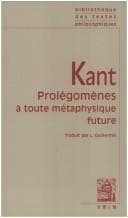
Kant's Prolegomena to Any Future MetaphysicsKant, Immanuel
PhilosophyPhilosophy
Kant's Prolegomena to Any Future Metaphysics
Kant, Immanuel
Knowledge, Theory of -- Early works to 1800; Metaphysics -- Early works to 1800
I find myself, with my reviewer, in quite another position. He seems
not to see at all the real matter of the investigation with which
(successfully or unsuccessfully) I have been occupied. It is either
impatience at thinking out a lengthy work, or vexation at a threatened
reform of a science in which he believed he had brought everything to
perfection long ago, or, what I am unwilling to imagine, real
narrowmindedness, that prevents him from ever carrying his thoughts
beyond his school-metaphysics. In short, he passes impatiently in
review a long series of propositions, by which, without knowing their
premises, we can think nothing, intersperses here and there his
censure, the reason of which the reader understands just as little as
the propositions against which it is directed; and hence [his report]
can neither serve the public nor damage me, in the judgment of
experts. I should, for these reasons, have passed over this judgment
altogether, were it not that it may afford me occasion for some
explanations which may in some cases save the readers of these
Prolegomena from a misconception.
In order to take a position from which my reviewer could most easily
set the whole work in a most unfavorable light, without venturing to
trouble himself with any special investigation, he begins and ends by
saying:
"This work is a system of transcendent (or, as he translates it, of
higher) Idealism."{45}
===================================
{45} By no means "higher." High towers, and metaphysically-great men
resembling them, round both of which there is commonly much wind, are
not for me. My place is the fruitful bathos, the bottom-land, of
experience; and the word transcendental, the meaning of which is so
often explained by me, but not once grasped by my reviewer (so
carelessly has he regarded everything), does not signify something
passing beyond all experience, but something that indeed precedes it a
priori, but that is intended simply to make cognition of experience
possible. If these conceptions overstep experience, their employment
is termed transcendent, a word which must be distinguished from
transcendental, the latter being limited to the immanent use, that is,
to experience. All misunderstandings of this kind have been
sufficiently guarded against in the work itself, but my reviewer found
his advantage in misunderstanding me.
===================================
A glance at this line soon showed me the sort of criticism that I had
to expect, much as though the reviewer were one who had never seen or
heard of geometry, having found a Euclid, and coming upon various
figures in turning over its leaves, were to say, on being asked his
opinion of it: "The work is a text-book of drawing; the author
introduces a peculiar terminology, in order to give dark,
incomprehensible directions, which in the end teach nothing more than
what every one can effect by a fair natural accuracy of eye, etc."
Public-domain text, read in full here on John Shaqi.
Reviews
Reviews
No reviews yet
Be the first to share your thoughts on this work.
Elsewhere in the archive
Join the Discussion
Join the discussion
Sign in to leave a comment or review.
Sign InorCreate an account