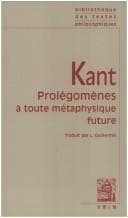
Kant's Prolegomena to Any Future MetaphysicsKant, Immanuel
PhilosophyPhilosophy
Kant's Prolegomena to Any Future Metaphysics
Kant, Immanuel
Knowledge, Theory of -- Early works to 1800; Metaphysics -- Early works to 1800
There are scholarly men, to whom the history of philosophy (both
ancient and modern) is philosophy itself; for these the present
Prolegomena are not written. They must wait till those who endeavor to
draw from the fountain of reason itself have completed their work; it
will then be the historian's turn to inform the world of what has been
done. Unfortunately, nothing can be said, which in their opinion has
not been said before, and truly the same prophecy applies to all
future time; for since the human reason has for many centuries
speculated upon innumerable objects in various ways, it is hardly to
be expected that we should not be able to discover analogies for every
new idea among the old sayings of past ages.
My object is to persuade all those who think Metaphysics worth
studying, that it is absolutely necessary to pause a moment, and,
neglecting all that has been done, to propose first the preliminary
question, ‘Whether such a thing as metaphysics be at all
possible?’
If it be a science, how comes it that it cannot, like other sciences,
obtain universal and permanent recognition? If not, how can it
maintain its pretensions, and keep the human mind in suspense with
hopes, never ceasing, yet never fulfilled? Whether then we demonstrate
our knowledge or our ignorance in this field, we must come once for
all to a definite conclusion respecting the nature of this so-called
science, which cannot possibly remain on its present footing. It seems
almost ridiculous, while every other science is continually advancing,
that in this, which pretends to be Wisdom incarnate, for whose oracle
every one inquires, we should constantly move round the same spot,
without gaining a single step. And so its followers having melted
away, we do not find men confident of their ability to shine in other
sciences venturing their reputation here, where everybody, however
ignorant in other matters, may deliver a final verdict, as in this
domain there is as yet no standard weight and measure to distinguish
sound knowledge from shallow talk.
After all it is nothing extraordinary in the elaboration of a science,
when men begin to wonder how far it has advanced, that the question
should at last occur, whether and how such a science is possible?
Human reason so delights in constructions, that it has several times
built up a tower, and then razed it to examine the nature of the
foundation. It is never too late to become wise; but if the change
comes late, there is always more difficulty in starting a reform.
Public-domain text, read in full here on John Shaqi.
Reviews
Reviews
No reviews yet
Be the first to share your thoughts on this work.
Join the Discussion
Join the discussion
Sign in to leave a comment or review.
Sign InorCreate an account