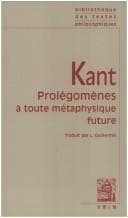
Kant's Prolegomena to Any Future Metaphysics — John Shaqi
Kant's Prolegomena to Any Future MetaphysicsKant, Immanuel
PhilosophyPhilosophy
Kant's Prolegomena to Any Future Metaphysics
Kant, Immanuel
Knowledge, Theory of -- Early works to 1800; Metaphysics -- Early works to 1800
It would be quite otherwise if the senses were so constituted as to
represent objects as they are in themselves. For then it would not by
any means follow from the conception of space, which with all its
properties serves to the geometer as an a priori foundation, together
with what is thence inferred, must be so in nature. The space of the
geometer would be considered a mere fiction, and it would not be
credited with objective validity, because we cannot see how things
must of necessity agree with an image of them, which we make
spontaneously and previous to our acquaintance with them. But if this
image, or rather this formal intuition, is the essential property of
our sensibility, by means of which alone objects are given to us, and
if this sensibility represents not things in themselves, but their
appearances: we shall easily comprehend, and at the same time
indisputably prove, that all external objects of our world of sense
must necessarily coincide in the most rigorous way with the
propositions of geometry; because sensibility by means of its form of
external intuition, viz., by space, the same with which the geometer
is occupied, makes those objects at all possible as mere appearances.
It will always remain a remarkable phenomenon in the history of
philosophy, that there was a time, when even mathematicians, who at
the same time were philosophers, began to doubt, not of the accuracy
of their geometrical propositions so far as they concerned space, but
of their objective validity and the applicability of this concept
itself, and of all its corollaries, to nature. They showed much
concern whether a line in nature might not consist of physical points,
and consequently that true space in the object might consist of simple
[discrete] parts, while the space which the geometer has in his mind
[being continuous] cannot be such. They did not recognise that this
mental space renders possible the physical space, i.e., the extension
of matter; that this pure space is not at all a quality of things in
themselves, but a form of our sensuous faculty of representation; and
that all objects in space are mere appearances, i.e., not things in
themselves but representations of our sensuous intuition. But such is
the case, for the space of the geometer is exactly the form of
sensuous intuition which we find a priori in us, and contains the
ground of the possibility of all external appearances (according to
their form), and the latter must necessarily and most rigidly agree
with the propositions of the geometer, which he draws not from any
fictitious concept, but from the subjective basis of all external
phenomena, which is sensibility itself. In this and no other way can
geometry be made secure as to the undoubted objective reality of its
propositions against all the intrigues of a shallow Metaphysics, which
is surprised at them [the geometrical propositions], because it has
not traced them to the sources of their concepts.
Remark II.
Public-domain text, read in full here on John Shaqi.
Reviews
Reviews
No reviews yet
Be the first to share your thoughts on this work.
Join the Discussion
Join the discussion
Sign in to leave a comment or review.
Sign InorCreate an account