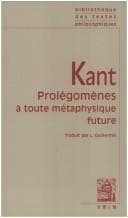
Kant's Prolegomena to Any Future MetaphysicsKant, Immanuel
PhilosophyPhilosophy
Kant's Prolegomena to Any Future Metaphysics
Kant, Immanuel
Knowledge, Theory of -- Early works to 1800; Metaphysics -- Early works to 1800
§ 15. We nevertheless actually possess a pure science of nature in
which are propounded, a priori and with all the necessity requisite to
apodeictical propositions, laws to which nature is subject. I need
only call to witness that propaedeutic of natural science which, under
the title of the universal Science of Nature, precedes all Physics
(which is founded upon empirical principles). In it we have
Mathematics applied to appearance, and also merely discursive
principles (or those derived from concepts), which constitute the
philosophical part of the pure cognition of nature. But there are
several things in it, which are not quite pure and independent of
empirical sources: such as the concept of motion, that of
impenetrability (upon which the empirical concept of matter rests),
that of inertia, and many others, which prevent its being called a
perfectly pure science of nature. Besides, it only refers to objects
of the external sense, and therefore does not give an example of a
universal science of nature, in the strict sense, for such a science
must reduce nature in general, whether it regards the object of the
external or that of the internal sense (the object of Physics as well
as Psychology), to universal laws. But among the principles of this
universal physics there are a few which actually have the required
universality; for instance, the propositions that "substance is
permanent," and that "every event is determined by a cause according
to constant laws," etc. These are actually universal laws of nature,
which subsist completely a priori. There is then in fact a pure
science of nature, and the question arises, How is it possible?
§ 16. The word "nature" assumes yet another meaning, which determines
the object, whereas in the former sense it only denotes the conformity
to law [Gesetzmässigkeit] of the determinations of the existence of
things generally. If we consider it materialiter (i.e., in the matter
that forms its objects) "nature is the complex of all the objects of
experience." And with this only are we now concerned, for besides,
things which can never be objects of experience, if they must be
cognised as to their nature, would oblige us to have recourse to
concepts whose meaning could never be given in concreto (by any
example of possible experience). Consequently we must form for
ourselves a list of concepts of their nature, the reality whereof
(i.e., whether they actually refer to objects, or are mere creations
of thought) could never be determined. The cognition of what cannot be
an object of experience would be hyperphysical, and with things
hyperphysical we are here not concerned, but only with the cognition
of nature, the actuality of which can be confirmed by experience,
though it [the cognition of nature] is possible a priori and precedes
all experience.
Public-domain text, read in full here on John Shaqi.
Reviews
Reviews
No reviews yet
Be the first to share your thoughts on this work.
Join the Discussion
Join the discussion
Sign in to leave a comment or review.
Sign InorCreate an account