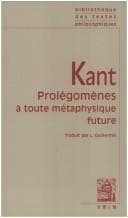
Kant's Prolegomena to Any Future MetaphysicsKant, Immanuel
PhilosophyPhilosophy
Kant's Prolegomena to Any Future Metaphysics
Kant, Immanuel
Knowledge, Theory of -- Early works to 1800; Metaphysics -- Early works to 1800
Hume started from a single but important concept in Metaphysics, viz.,
that of Cause and Effect (including its derivatives force and action,
etc.). He challenges reason, which pretends to have given birth to
this idea from herself, to answer him by what right she thinks
anything to be so constituted, that if that thing be posited,
something else also must necessarily be posited; for this is the
meaning of the concept of cause. He demonstrated irrefutably that it
was perfectly impossible for reason to think a priori and by means of
concepts a combination involving necessity. We cannot at all see why,
in consequence of the existence of one thing, another must necessarily
exist, or how the concept of such a combination can arise a priori.
Hence he inferred, that reason was altogether deluded with reference
to this concept, which she erroneously considered as one of her
children, whereas in reality it was nothing but a bastard of
imagination, impregnated by experience, which subsumed certain
representations under the Law of Association, and mistook the
subjective necessity of habit for an objective necessity arising from
insight. Hence he inferred that reason had no power to think such
combinations, even generally, because her concepts would then be
purely fictitious, and all her pretended a priori cognitions nothing
but common experiences marked with a false stamp. In plain language
there is not, and cannot be, any such thing as metaphysics at all.{6}
===================================
{6} Nevertheless Hume called this very destructive science metaphysics
and attached to it great value. Metaphysics and morals [he declares in
the fourth part of his Essays] are the most important branches of
science; mathematics and physics are not nearly so important. But the
acute man merely regarded the negative use arising from the moderation
of extravagant claims of speculative reason, and the complete
settlement of the many endless and troublesome controversies that
mislead mankind. He overlooked the positive injury which results, if
reason be deprived of its most important prospects, which can alone
supply to the will the highest aim for all its endeavor.
===================================
However hasty and mistaken Hume's conclusion may appear, it was at
least founded upon investigation, and this investigation deserved the
concentrated attention of the brighter spirits of his day as well as
determined efforts on their part to discover, if possible, a happier
solution of the problem in the sense proposed by him, all of which
would have speedily resulted in a complete reform of the science.
Public-domain text, read in full here on John Shaqi.
Reviews
Reviews
No reviews yet
Be the first to share your thoughts on this work.
Join the Discussion
Join the discussion
Sign in to leave a comment or review.
Sign InorCreate an account