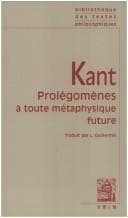
Kant's Prolegomena to Any Future MetaphysicsKant, Immanuel
PhilosophyPhilosophy
Kant's Prolegomena to Any Future Metaphysics
Kant, Immanuel
Knowledge, Theory of -- Early works to 1800; Metaphysics -- Early works to 1800
Our principles, which limit the use of reason to possible experience,
might in this way become transcendent, and the limits of our reason be
set up as limits of the possibility of things in themselves (as Hume's
dialogues may illustrate), if a careful critique did not guard the
bounds of our reason with respect to its empirical use, and set a
limit to its pretensions. Scepticism originally arose from metaphysics
and its licentious dialectics. At first it might, merely to favor the
empirical use of reason, announce everything that transcends this use
as worthless and deceitful; but by and by, when it was perceived that
the very same principles that are used in experience, insensibly, and
apparently with the same right, led still further than experience
extends, then men began to doubt even the propositions of experience.
But here there is no danger; for common sense will doubtless always
assert its rights. A certain confusion, however, arose in science
which cannot determine how far reason is to be trusted, and why only
so far and no further, and this confusion can only be cleared up and
all future relapses obviated by a formal determination, on principle,
of the boundary of the use of our reason.
We cannot indeed, beyond all possible experience, form a definite
notion of what things in themselves may be. Yet we are not at liberty
to abstain entirely from inquiring into them; for experience never
satisfies reason fully, but in answering questions, refers us further
and further back, and leaves us dissatisfied with regard to their
complete solution. This any one may gather from the Dialectics of pure
reason, which therefore has its good subjective grounds. Having
acquired, as regards the nature of our soul, a clear conception of the
subject, and having come to the conviction, that its manifestations
cannot be explained materialistically, who can refrain from asking
what the soul really is, and, if no concept of experience suffices for
the purpose, from accounting for it by a concept of reason (that of a
simple immaterial being), though we cannot by any means prove its
objective reality? Who can satisfy himself with mere empirical
knowledge in all the cosmological questions of the duration and of the
quantity of the world, of freedom or of natural necessity, since every
answer given on principles of experience begets a fresh question,
which likewise requires its answer and thereby clearly shows the
insufficiency of all physical modes of explanation to satisfy reason?
Finally, who does not see in the thorough-going contingency and
dependence of all his thoughts and assumptions on mere principles of
experience, the impossibility of stopping there? And who does not feel
himself compelled, notwithstanding all interdictions against losing
himself in transcendent ideas, to seek rest and contentment beyond all
the concepts which he can vindicate by experience, in the concept of a
Being, the possibility of which we cannot conceive, but at the same
Public-domain text, read in full here on John Shaqi.
Reviews
Reviews
No reviews yet
Be the first to share your thoughts on this work.
Elsewhere in the archive
Join the Discussion
Join the discussion
Sign in to leave a comment or review.
Sign InorCreate an account