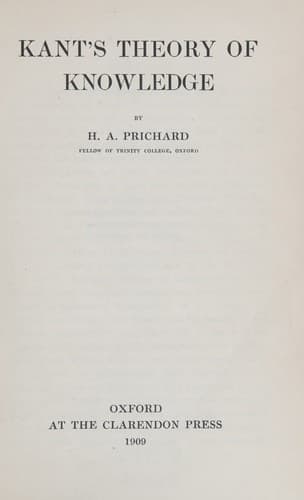
Kant's Theory of KnowledgePrichard, H. A. (Harold Arthur)
Philosophy
Kant's Theory of Knowledge
Prichard, H. A. (Harold Arthur)
Kant, Immanuel, 1724-1804; Knowledge, Theory of
Kant has been led into the mistake by a momentary change in the
meaning given to 'metaphysics'. For the moment he is thinking of
metaphysics, not as the inquiry concerned with God, freedom, and
immortality, but as the inquiry which has to deal with the problem as
to how we can know _a priori_. This problem is assisted, at any rate
prima facie, by the assumption that things must conform to the mind.
And this assumption can be said to be suggested by mathematics,
inasmuch as the mathematician presupposes that particular objects must
correspond to the general rules discovered by the mind. From this
point of view Kant's only mistake, if the parallelism is to be
maintained, is that he takes for an assumption which enables the
mathematician to advance a metaphysical presupposition of the advance,
on which the mathematician never reflects, and awareness of which
would in no way assist his mathematics.
In the second place the 'Copernican' revolution is not strictly the
revolution which Kant supposes it to be. He speaks as though his aim
is precisely to reverse the ordinary view of the relation of the mind
to objects. Instead of the mind being conceived as having to conform
to objects, objects are to be conceived as having to conform to the
mind. But if we consider Kant's real position, we see that these views
are only verbally contrary, since the word object refers to something
different in each case. On the ordinary view objects are something
outside the mind, in the sense of independent of it, and the ideas,
which must conform to objects, are something within the mind, in the
sense of dependent upon it. The conformity then is of something within
the mind to something outside it. Again, the conformity means that one
of the terms, viz. the object, exists first and that then the other
term, the idea, is fitted to or made to correspond to it. Hence the
real contrary of this view is that ideas, within the mind, exist first
and that objects outside the mind, coming into existence afterwards,
must adapt themselves to the ideas. This of course strikes us as
absurd, because we always think of the existence of the object as the
presupposition of the existence of the knowledge of it; we do not
think the existence of the knowledge as the presupposition of the
existence of the object. Hence Kant only succeeds in stating the
contrary of the ordinary view with any plausibility, because in doing
so he makes the term object refer to something which like 'knowledge'
is within the mind. His position is that objects within the mind must
conform to our general ways of knowing. For Kant, therefore, the
conformity is not between something within and something without the
mind, but between two realities within the mind, viz. the individual
object, as object of perception, i. e. a phenomenon, and our general
ways of perceiving and thinking. But this view is only verbally the
contrary of the ordinary view, and consequently Kant does not succeed
Public-domain text, read in full here on John Shaqi.
Reviews
Reviews
No reviews yet
Be the first to share your thoughts on this work.
Join the Discussion
Join the discussion
Sign in to leave a comment or review.
Sign InorCreate an account