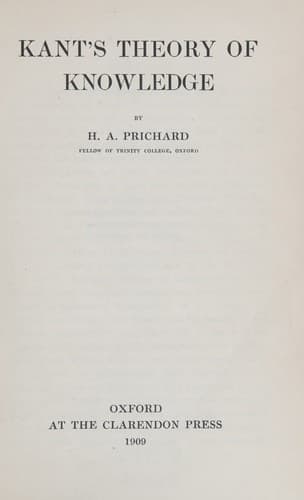
Kant's Theory of KnowledgePrichard, H. A. (Harold Arthur)
Philosophy
Kant's Theory of Knowledge
Prichard, H. A. (Harold Arthur)
Kant, Immanuel, 1724-1804; Knowledge, Theory of
[13.] "Now this principle of the necessary unity of apperception is
indeed an identical, and therefore an analytical, proposition, but
nevertheless it declares a synthesis of the manifold given in a
perception to be necessary, without which the thorough-going identity
of self-consciousness cannot be thought. [14.] For through the Ego, as
a simple representation, is given no manifold content; in perception,
which is different from it, a manifold can only be given, and through
_connexion_ in one consciousness it can be thought. An understanding,
through whose self-consciousness all the manifold would _eo ipso_ be
given, would _perceive_; our understanding can only _think_ and must
seek its perception in the senses. [15.] I am, therefore, conscious of
the identical self, in relation to the manifold of representations
given to me in a perception, because I call all those representations
_mine_, which constitute _one_. [16.] But this is the same as to say
that I am conscious _a priori_ of a necessary synthesis of them, which
is called the original synthetic unity of apperception, under which
all representations given to me stand, but also under which they must
be brought through a synthesis."[68]
[68] B. 131-5, M. 81-4.
Though this passage involves many difficulties, the main drift of it
is clear. Kant is anxious to establish the fact that the manifold of
sense must be capable of being combined on principles, which
afterwards turn out to be the categories, by showing this to be
involved in the fact that we must be capable of being conscious of
ourselves as the identical subject of all our representations. To do
this, he seeks to prove in the first paragraph that self-consciousness
in this sense must be possible, and in the second that this
self-consciousness presupposes the synthesis of the manifold.
Examination of the argument, however, shows that the view that
self-consciousness must be possible is, so far as Kant is
concerned,[69] an assumption for which Kant succeeds in giving no
reason at all, and that even if it be true, it cannot form a basis
from which to deduce the possibility of the synthesis.
[69] Cf. p. 204, note 3.
Public-domain text, read in full here on John Shaqi.
Reviews
Reviews
No reviews yet
Be the first to share your thoughts on this work.
Elsewhere in the archive
Join the Discussion
Join the discussion
Sign in to leave a comment or review.
Sign InorCreate an account